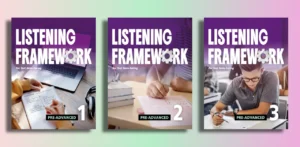
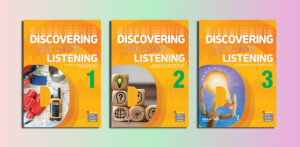
Listening Framework Pre-advanced (PDFs, Resources)
Level 1 (B2)
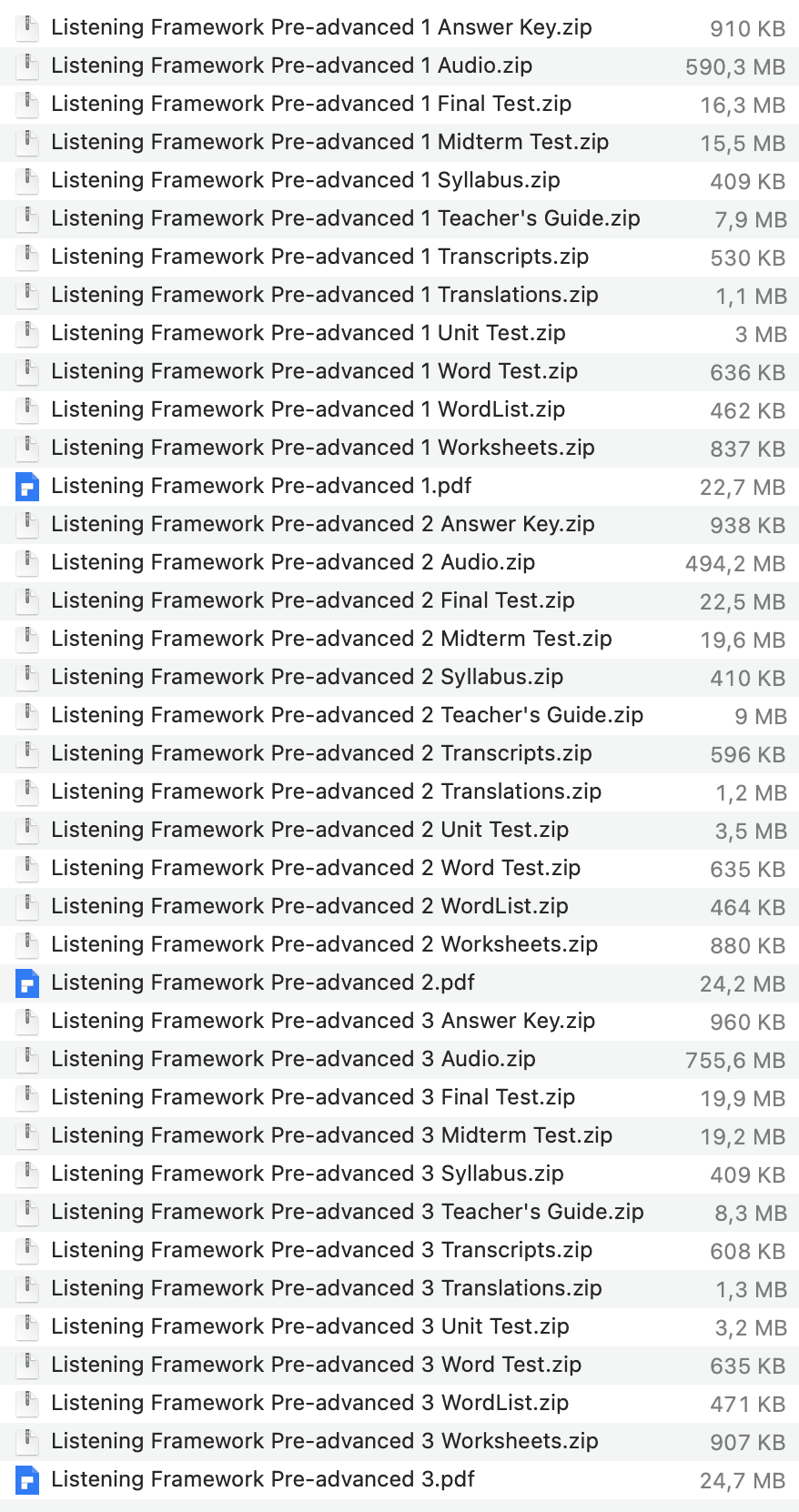
Listening Framework Pre-advanced 1 Answer Key.zip
Listening Framework Pre-advanced 1 Audio.zip
Listening Framework Pre-advanced 1 Final Test.zip
Listening Framework Pre-advanced 1 Midterm Test.zip
Listening Framework Pre-advanced 1 Syllabus.zip
Listening Framework Pre-advanced 1 Teacher’s Guide.zip
Listening Framework Pre-advanced 1 Transcripts.zip
Listening Framework Pre-advanced 1 Translations.zip
Listening Framework Pre-advanced 1 Unit Test.zip
Listening Framework Pre-advanced 1 Word Test.zip
Listening Framework Pre-advanced 1 WordList.zip
Listening Framework Pre-advanced 1 Worksheets.zip
Listening Framework Pre-advanced 1.pdf – Sample: Click
Level 2 (B2)
Listening Framework Pre-advanced 2 Answer Key.zip
Listening Framework Pre-advanced 2 Audio.zip
Listening Framework Pre-advanced 2 Final Test.zip
Listening Framework Pre-advanced 2 Midterm Test.zip
Listening Framework Pre-advanced 2 Syllabus.zip
Listening Framework Pre-advanced 2 Teacher’s Guide.zip
Listening Framework Pre-advanced 2 Transcripts.zip
Listening Framework Pre-advanced 2 Translations.zip
Listening Framework Pre-advanced 2 Unit Test.zip
Listening Framework Pre-advanced 2 Word Test.zip
Listening Framework Pre-advanced 2 WordList.zip
Listening Framework Pre-advanced 2 Worksheets.zip
Listening Framework Pre-advanced 2.pdf – Sample: Click
Level 3 (B2+)
Listening Framework Pre-advanced 3 Answer Key.zip
Listening Framework Pre-advanced 3 Audio.zip
Listening Framework Pre-advanced 3 Final Test.zip
Listening Framework Pre-advanced 3 Midterm Test.zip
Listening Framework Pre-advanced 3 Syllabus.zip
Listening Framework Pre-advanced 3 Teacher’s Guide.zip
Listening Framework Pre-advanced 3 Transcripts.zip
Listening Framework Pre-advanced 3 Translations.zip
Listening Framework Pre-advanced 3 Unit Test.zip
Listening Framework Pre-advanced 3 Word Test.zip
Listening Framework Pre-advanced 3 WordList.zip
Listening Framework Pre-advanced 3 Worksheets.zip
Listening Framework Pre-advanced 3.pdf – Sample: Click
๏ Listening Framework Basic (Pre A1 / A1+): Click here
๏ Listening Framework Elementary (A2 / A2+): Click here
๏ Listening Framework Intermediate (B1 / B1+): Click here
๏ Listening Framework Pre-Advanced (B2 / B2+): Click here
| Name | Price | Buy |
|---|---|---|
| Listening Framework Pre-advanced 1 PDFs, Resources | $8 | |
| Listening Framework Pre-advanced 2 PDFs, Resources | $8 | |
| Listening Framework Pre-advanced 3 PDFs, Resources | $8 | |
| Listening Framework Pre-advanced PDFs, Resources - All 3 Levels | Original price was: $24.$20Current price is: $20. |
| Name | Price | Buy |
|---|---|---|
| Listening Framework Basic 1 PDFs, Resources | $8 | |
| Listening Framework Basic 2 PDFs, Resources | $8 | |
| Listening Framework Basic 3 PDFs, Resources | $8 | |
| Listening Framework Basic PDFs, Resources - All 3 Levels | Original price was: $24.$20Current price is: $20. |
| Name | Price | Buy |
|---|---|---|
| Listening Framework Elementary 1 PDFs, Resources | $8 | |
| Listening Framework Elementary 2 PDFs, Resources | $8 | |
| Listening Framework Elementary 3 PDFs, Resources | $8 | |
| Listening Framework Elementary PDFs, Resources - All 3 Levels | Original price was: $24.$20Current price is: $20. |
| Name | Price | Buy |
|---|---|---|
| Listening Framework Intermediate 1 PDFs, Resources | $8 | |
| Listening Framework Intermediate 2 PDFs, Resources | $8 | |
| Listening Framework Intermediate 3 PDFs, Resources | $8 | |
| Listening Framework Intermediate PDFs, Resources - All 3 Levels | Original price was: $24.$20Current price is: $20. |

Overview of “Listening Framework Pre-advanced” by Compass Publishing
Contents
| ✅ Coursebook: | Listening Framework Pre-advanced |
| ✅ Authors: | J Collective Edu, Inc., Peter Chin |
| ✅ Publisher: | Compass Publishing |
| ✅ Levels: | B2, B2+ |
| ✅ English type: | International English |
| ✅ For: | Secondary, Junior High School, High School |
| ✅ Publication year: | 2025 |
Listening Framework Pre-advanced by Compass Publishing is a structured listening course designed for upper-intermediate learners who are preparing to move confidently toward advanced English proficiency. Positioned around the B2 level, the series helps students strengthen their ability to understand longer, more complex spoken texts while developing the vocabulary, note-taking skills, and listening strategies needed for academic, professional, and real-world communication.
Unlike basic listening courses that focus mainly on short dialogues or simple comprehension tasks, Listening Framework Pre-advanced introduces learners to richer audio content, more detailed information, and more challenging question types. This makes it especially useful for students who already have a solid foundation in English but need more systematic practice to improve accuracy, speed, and confidence when listening to natural spoken English.
What Makes Listening Framework Pre-advanced Effective?
One of the key strengths of Listening Framework Pre-advanced is its clear and progressive learning framework. Each unit is designed to guide learners from preparation to comprehension, then from analysis to practical application. This step-by-step approach helps students build listening ability in a manageable and measurable way.
The course supports learners through:
- Pre-listening activities that activate background knowledge and introduce key vocabulary
- Focused listening tasks that train students to identify main ideas, details, speaker opinions, and implied meaning
- Vocabulary development to help learners understand topic-specific and academic language
- Post-listening exercises that encourage reflection, discussion, and deeper comprehension
- Review and test materials that allow teachers and students to monitor progress effectively
This structure reflects a research-based understanding of how listening skills develop: learners need repeated exposure, clear objectives, meaningful context, and opportunities to process spoken language at different levels of difficulty.

Listening Framework Pre-advanced 1
A Strong Choice for B2 Learners
At the pre-advanced stage, many learners can understand everyday English but still struggle with longer recordings, faster speech, unfamiliar accents, or more abstract topics. Listening Framework Pre-advanced addresses these challenges by helping students move beyond basic comprehension and toward more analytical listening.
Learners are encouraged to listen not only for “what was said,” but also for purpose, tone, organization, supporting details, and speaker intention. These are essential skills for students preparing for international exams, academic study, classroom discussions, presentations, or professional communication in English.
Useful Resources for Teachers and Self-study
The series is also practical for teachers because it includes a wide range of supporting resources. Depending on the level, materials may include audio files, answer keys, transcripts, translations, worksheets, syllabus files, unit tests, word tests, midterm tests, final tests, teacher’s guides, and word lists.
These resources make Listening Framework Pre-advanced suitable for:
- English language classrooms
- Private tutoring programs
- Exam preparation courses
- Listening-focused workshops
- Independent study at home
- Supplementary practice for B2 learners
Teachers can use the materials to design complete lessons, assign homework, assess student progress, and provide additional support for learners who need more practice with listening comprehension.
Educational Value of the Course
From an educational perspective, Listening Framework Pre-advanced is valuable because it treats listening as an active skill rather than a passive activity. Students are not simply asked to hear and answer; they are trained to predict, focus, infer, organize information, and evaluate meaning. This reflects how successful listeners operate in real-life communication.
The course also helps learners develop greater confidence. As students become familiar with different listening tasks and text types, they begin to approach spoken English with better strategies and less anxiety. Over time, this can improve not only listening performance but also speaking, pronunciation awareness, vocabulary use, and overall communicative competence.
Conclusion
Listening Framework Pre-advanced by Compass Publishing is a well-organized and academically useful listening course for B2-level learners who want to strengthen their comprehension of more complex English. With its clear structure, practical exercises, rich audio support, and teacher-friendly resources, it provides a strong bridge between intermediate listening ability and advanced-level communication.
For students, it offers focused and meaningful listening practice. For teachers, it provides a complete set of tools for planning, teaching, reviewing, and assessing progress. Overall, Listening Framework Pre-advanced is an excellent choice for learners who are ready to improve their listening accuracy, expand their vocabulary, and develop the confidence needed for higher-level English communication.

Listening Framework Pre-advanced 2
Who is suitable for “Listening Framework Pre-advanced”?
Listening Framework Pre-advanced is suitable for upper-intermediate English learners, especially students around the B2 level who already understand everyday English but want to improve their ability to listen to longer, more detailed, and more academic spoken texts.
This course is especially useful for:
- B2-level students who want to move toward advanced listening proficiency
- Teenagers and young adults preparing for higher-level English study
- Learners who can understand basic conversations but still struggle with longer recordings, fast speech, or detailed information
- Students preparing for English exams that require strong listening comprehension, note-taking, vocabulary recognition, and inference skills
- Academic English learners who need to understand lectures, presentations, discussions, and information-rich audio texts
- Teachers and language centers looking for a structured listening course with audio, transcripts, worksheets, tests, word lists, and teacher support materials
- Self-study learners who want a clear listening framework to practice independently and track their progress
Overall, Listening Framework Pre-advanced is ideal for learners who are no longer beginners, but still need guided practice to listen more accurately, understand deeper meaning, and build confidence with real-world and academic English.

Listening Framework Pre-advanced 3
The benefits of “Listening Framework Pre-advanced”
Listening Framework Pre-advanced offers many practical benefits for learners who want to strengthen their listening skills at the upper-intermediate level. It is designed to help students move beyond basic understanding and develop the confidence to handle longer, more complex, and more natural spoken English.
1. Builds Stronger Listening Comprehension
The course helps learners understand spoken English more accurately by training them to identify main ideas, supporting details, sequence, speaker opinions, and implied meaning. This is especially important for students who need to listen to lectures, interviews, presentations, discussions, and exam-style audio tasks.
2. Develops Academic and Real-world Listening Skills
At the pre-advanced level, students need more than simple conversation practice. Listening Framework Pre-advanced exposes learners to richer topics and more structured listening tasks, helping them prepare for academic study, classroom communication, professional situations, and everyday conversations with greater confidence.
3. Expands Vocabulary and Topic Knowledge
The series introduces useful vocabulary across different themes, allowing students to improve both language knowledge and background understanding. By learning words and expressions in meaningful listening contexts, learners can remember vocabulary more effectively and use it more naturally in speaking and writing.
4. Improves Note-taking and Information Processing
Many listening tasks require students to organize information, recognize key points, and follow the logic of spoken texts. These activities support better note-taking habits and help learners process information quickly—an essential skill for exams, university preparation, and real-life communication.
5. Encourages Active Listening Strategies
Rather than simply playing audio and answering questions, the course guides students to predict content, listen with a purpose, check understanding, infer meaning, and review mistakes. These strategies help learners become more independent and more effective listeners.
6. Supports Exam Preparation
Listening Framework Pre-advanced is highly useful for learners preparing for English proficiency exams or school assessments. Its structured tasks, tests, transcripts, answer keys, and review materials give students regular opportunities to practice exam-related listening skills in a systematic way.
7. Provides Rich Support for Teachers
Teachers can benefit from the course’s ready-to-use resources, including audio files, transcripts, translations, worksheets, word lists, teacher’s guides, unit tests, midterm tests, and final tests. These materials make lesson planning easier and help teachers assess student progress more clearly.
8. Suitable for Both Classroom and Self-study
The clear structure of the course makes it flexible for different learning environments. It can be used in language centers, school programs, private tutoring, exam preparation classes, or independent study. Learners can follow the materials step by step and monitor their improvement over time.
9. Builds Confidence with Complex English
One of the biggest benefits of Listening Framework Pre-advanced is that it helps learners feel more comfortable with challenging listening materials. As students practice regularly, they become less dependent on slow or simplified English and more prepared to understand natural speech.
Conclusion
Listening Framework Pre-advanced is a valuable listening course for B2-level learners who want to improve accuracy, vocabulary, note-taking, and confidence. With its structured lessons and comprehensive support resources, it helps students develop the listening skills needed for academic success, exam preparation, and real-world English communication.
Effective learning strategies for “Listening Framework Pre-advanced”
To get the best results from Listening Framework Pre-advanced, learners should use the course as more than a simple listen-and-answer textbook. At the pre-advanced level, effective listening practice requires preparation, repeated exposure, active thinking, and careful review.
1. Preview the Topic Before Listening
Before starting each unit, students should look at the title, pictures, keywords, and questions. This helps activate background knowledge and prepares the brain to predict possible content.
Learners should ask themselves:
- What is the topic about?
- What vocabulary might appear?
- What information do I expect to hear?
- What do I already know about this subject?
This strategy makes listening more purposeful and reduces confusion when the audio begins.
2. Learn Key Vocabulary First
At the B2 level, listening difficulty often comes from unfamiliar words, academic expressions, or topic-specific language. Students should study the unit vocabulary before listening to the main audio.
A good method is to create a small vocabulary list with:
- Word or phrase
- Meaning
- Example sentence
- Pronunciation
- Related words or collocations
This helps learners recognize words faster when they hear them in context.
3. Listen for the Main Idea First
The first listening should focus on general understanding, not every small detail. Students should try to answer: “What is the speaker mainly talking about?”
Do not pause too often during the first listening. The goal is to understand the overall message, speaker purpose, and structure of the audio.
4. Listen Again for Details
During the second listening, students should focus on specific information such as numbers, names, reasons, examples, opinions, and sequence. This is the stage where learners can complete comprehension tasks more accurately.
Useful questions include:
- What details support the main idea?
- What examples does the speaker give?
- What problem or solution is mentioned?
- What is the speaker’s attitude?
5. Use the Transcript After Listening
The transcript should not be used too early. Students should first listen without reading, then check the transcript afterward to identify what they missed.
When reviewing the transcript, learners should mark:
- New vocabulary
- Fast connected speech
- Words they misheard
- Important phrases
- Grammar patterns used in natural speech
This turns mistakes into clear learning points.
6. Practice Shadowing
Shadowing is an excellent technique for improving listening, pronunciation, rhythm, and fluency. Students listen to a short part of the audio and repeat immediately after the speaker, trying to copy the stress, intonation, and speed.
Start with short sections of 10–20 seconds, then gradually increase the length. This helps learners become more comfortable with natural English pronunciation.
7. Take Notes While Listening
Since Listening Framework Pre-advanced often includes longer and more information-rich texts, learners should practice note-taking. They should not try to write every word. Instead, they should focus on keywords, main points, examples, and connections between ideas.
A simple note-taking format:
- Main idea
- Key details
- Examples
- Speaker opinion
- Conclusion
This is especially useful for exam preparation and academic listening.
8. Review Mistakes Carefully
After completing the exercises, students should not only check the answer key but also understand why an answer is correct or incorrect. This step is essential for long-term improvement.
Learners should ask:
- Did I miss the keyword?
- Did I misunderstand the speaker’s opinion?
- Was the answer implied rather than directly stated?
- Did I confuse similar-sounding words?
- Did I lose focus during the recording?
Careful error analysis helps students improve faster than simply repeating exercises.
9. Recycle Vocabulary Regularly
Vocabulary from each unit should be reviewed several times. Students can use word lists, flashcards, short speaking practice, or writing sentences to recycle new language.
For better retention, review vocabulary:
- Immediately after the lesson
- One day later
- One week later
- Before the unit test or review test
Repeated review helps vocabulary become active and easier to recognize in future listening tasks.
10. Combine Listening with Speaking
After each unit, learners should summarize the audio or discuss the topic in their own words. This strengthens comprehension and helps students transfer listening input into speaking ability.
Good post-listening activities include:
- Summarizing the main idea
- Retelling the audio from memory
- Giving a personal opinion
- Discussing the topic with a partner
- Creating questions based on the audio
Conclusion
The most effective way to study Listening Framework Pre-advanced is to follow a complete learning cycle: prepare before listening, listen for main ideas, listen again for details, review with the transcript, practice pronunciation, recycle vocabulary, and analyze mistakes carefully.
With consistent practice, learners can improve not only listening accuracy but also vocabulary, pronunciation awareness, note-taking ability, and confidence with more complex English.