Download, National Geographic
NGL Voices PDFs & Resources (American English, A1–C1)
Voices American English (PDFs Resources)
Level 1 (A1)
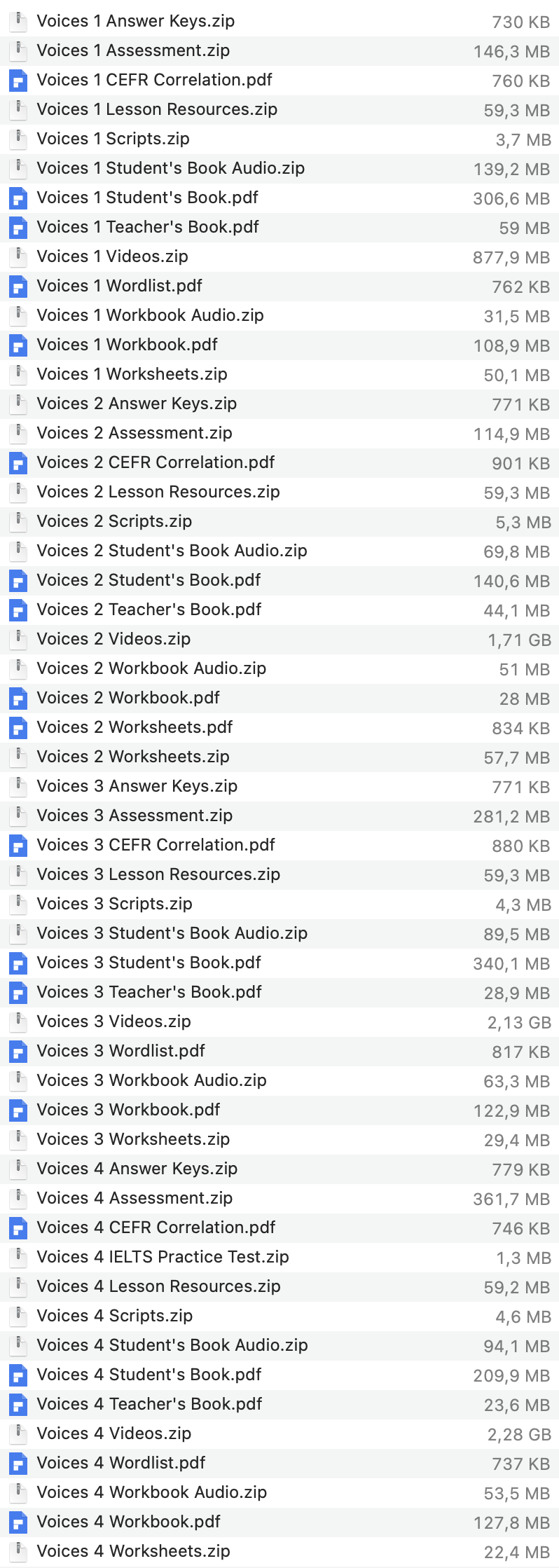
Voices 1 Answer Keys.zip
Voices 1 Assessment.zip
Voices 1 CEFR Correlation.pdf
Voices 1 Lesson Resources.zip
Voices 1 Scripts.zip
Voices 1 Student’s Book Audio.zip
Voices 1 Student’s Book.pdf – Sample: Click
Voices 1 Teacher’s Book.pdf – Sample: Click
Voices 1 Videos.zip
Voices 1 Wordlist.pdf
Voices 1 Workbook Audio.zip
Voices 1 Workbook.pdf – Sample: Click
Voices 1 Worksheets.zip
Level 2 (A2)
Voices 2 Answer Keys.zip
Voices 2 Assessment.zip
Voices 2 CEFR Correlation.pdf
Voices 2 Lesson Resources.zip
Voices 2 Scripts.zip
Voices 2 Student’s Book Audio.zip
Voices 2 Student’s Book.pdf – Sample: Click
Voices 2 Teacher’s Book.pdf – Sample: Click
Voices 2 Videos.zip
Voices 2 Workbook Audio.zip
Voices 2 Workbook.pdf – Sample: Click
Voices 2 Worksheets.pdf
Voices 2 Worksheets.zip
Level 3 (A2 – B1)
Voices 3 Answer Keys.zip
Voices 3 Assessment.zip
Voices 3 CEFR Correlation.pdf
Voices 3 Lesson Resources.zip
Voices 3 Scripts.zip
Voices 3 Student’s Book Audio.zip
Voices 3 Student’s Book.pdf – Sample: Click
Voices 3 Teacher’s Book.pdf – Sample: Click
Voices 3 Videos.zip
Voices 3 Wordlist.pdf
Voices 3 Workbook Audio.zip
Voices 3 Workbook.pdf – Sample: Click
Voices 3 Worksheets.zip
Level 4 (B1)
Voices 4 Answer Keys.zip
Voices 4 Assessment.zip
Voices 4 CEFR Correlation.pdf
Voices 4 IELTS Practice Test.zip
Voices 4 Lesson Resources.zip
Voices 4 Scripts.zip
Voices 4 Student’s Book Audio.zip
Voices 4 Student’s Book.pdf – Sample: Click
Voices 4 Teacher’s Book.pdf – Sample: Click
Voices 4 Videos.zip
Voices 4 Wordlist.pdf
Voices 4 Workbook Audio.zip
Voices 4 Workbook.pdf – Sample: Click
Voices 4 Worksheets.zip
Level 5 (B1-B2)
Voices 5 Answer Keys.zip
Voices 5 Assessment.zip
Voices 5 CEFR Correlation.pdf
Voices 5 IELTS Practice Test.zip
Voices 5 Lesson Resources.zip
Voices 5 Scripts.zip
Voices 5 Student’s Book Audio.zip
Voices 5 Student’s Book.pdf – Sample: Click
Voices 5 Teacher’s Book.pdf – Sample: Click
Voices 5 Videos.zip
Voices 5 Wordlist.pdf
Voices 5 Workbook Audio.zip
Voices 5 Workbook.pdf – Sample: Click
Voices 5 Worksheets.zip
Level 6 (B2)
Voices 6 Answer Keys.zip
Voices 6 Assessment.zip
Voices 6 CEFR Correlation.pdf
Voices 6 Lesson Resources.zip
Voices 6 Scripts.zip
Voices 6 Student’s Book Audio.zip
Voices 6 Student’s Book.pdf – Sample: Click
Voices 6 Teacher’s Book.pdf – Sample: Click
Voices 6 Videos.zip
Voices 6 Wordlists.pdf
Voices 6 Workbook Audio.zip
Voices 6 Workbook.pdf – Sample: Click
Voices 6 Worksheets.zip
Level 7 (C1)
Voices 7 Answer Keys.zip
Voices 7 Assessment.zip
Voices 7 CEFR Correlation.pdf
Voices 7 Lesson Resources.zip
Voices 7 Scripts.zip
Voices 7 Student’s Book Audio.zip
Voices 7 Student’s Book.pdf – Sample: Click
Voices 7 Teacher’s Book.pdf – Sample: Click
Voices 7 Videos.zip
Voices 7 Wordlist.pdf
Voices 7 Workbook Audio.zip
Voices 7 Workbook.pdf – Sample: Click
Voices 7 Worksheets.zip
Voices All Levels Pacing Guides.pdf
Voices All Levels Voices And IELTS.pdf
Voices Professional Development Resources.zip
๏ Voices (British English): Click here
| Image | Name | Price | Buy |
|---|---|---|---|
 | Voices 1 PDFs & Resources | $10 | |
 | Voices 2 PDFs & Resources | $10 | |
 | Voices 3 PDFs & Resources | $10 | |
 | Voices 4 PDFs & Resources | $10 | |
 | Voices 5 PDFs & Resources | $10 | |
 | Voices 6 PDFs & Resources | $10 | |
 | Voices 7 PDFs & Resources | $10 | |
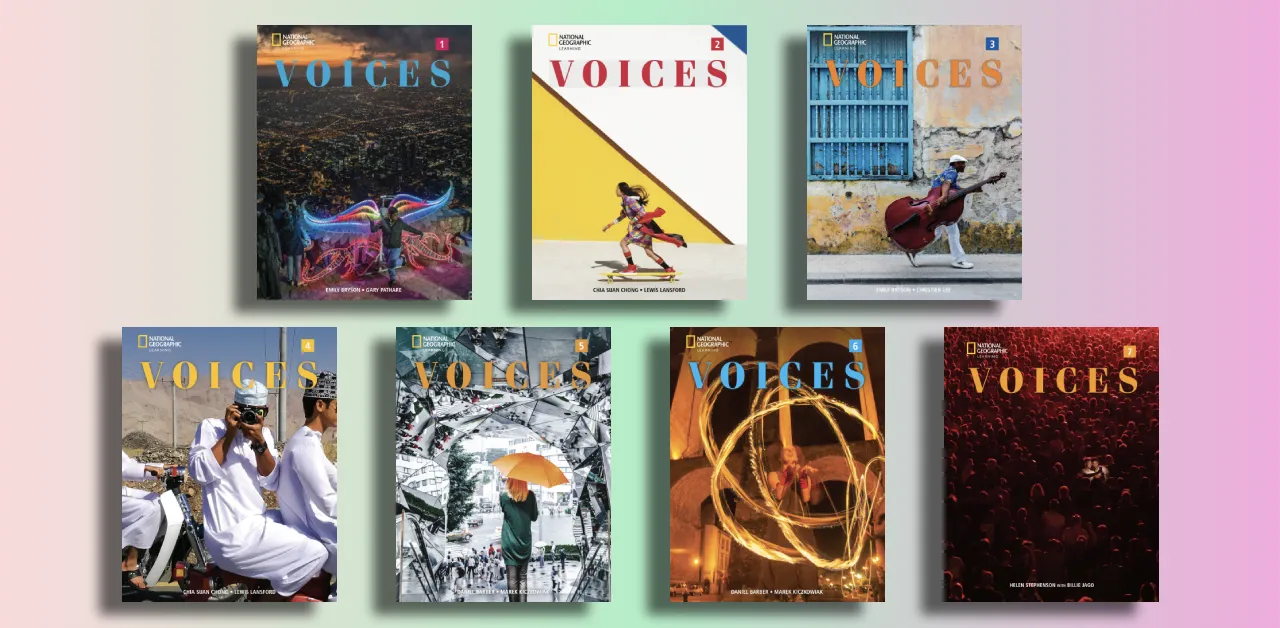 | Voices All 7 Levels PDFs & Resources (American English) | Original price was: $70.$60Current price is: $60. |
Overview of the “Voices American English” by NGL
Contents
- 1 Overview of the “Voices American English” by NGL
- 2 What Is Voices American English?
- 3 The Educational Philosophy Behind Voices
- 4 Key Features of Voices American English
- 5 Recurring Learning Strands
- 6 National Geographic Content in the Classroom
- 7 Listening and Video-Based Learning
- 8 Writing Development
- 9 A Seven-Level Learning Pathway from A1 to C1
- 10 Course Components and Teaching Resources
- 11 Who Is Voices American English Suitable For?
- 12 Benefits for English Learners
- 13 Benefits for Teachers and Institutions
- 14 Important Teaching Considerations
- 15 How Voices Differs from Traditional English Courses
- 16 Why Voices Remains Relevant for Modern English Education
- 17 Frequently Asked Questions
- 18 Final Evaluation
| ✅ Coursebook: | Voices |
| ✅ Authors: | Chia Suan Chong, Lewis Lansford, Emily Bryson, Christien Lee, Daniel Barber, Marek Kiczkowiak |
| ✅ Publisher: | National Geographic Learning |
| ✅ 7 Levels: | A1, A2, B1, B2, C1 |
| ✅ English type: | American English |
| ✅ For: | Adult, Young Adult |
| ✅ Publication year: | 2022 |
Voices American English is a seven-level English language course from National Geographic Learning, designed for adult and young adult learners who want to communicate confidently in an increasingly connected world. Covering the CEFR A1 to C1 range, the series combines systematic language development with real-world stories, international perspectives, practical communication tasks, and visually engaging National Geographic content.
Rather than treating English as a collection of grammar rules and vocabulary lists, Voices presents it as a tool for participating in conversations, understanding different perspectives, expressing personal ideas, and building meaningful connections across cultures. This communication-centered philosophy gives the series a distinctive place among contemporary general English courses.
What Is Voices American English?
Voices is an integrated-skills program that develops listening, speaking, reading, writing, grammar, vocabulary, and pronunciation within a coherent learning pathway. The American English edition uses American spelling, vocabulary, pronunciation models, and language conventions while maintaining the international outlook associated with National Geographic Learning.
The course is organized into seven progressive levels, allowing institutions and learners to follow a continuous program from elementary language development to advanced communication. Its overall CEFR coverage extends from A1 to C1, making it suitable for long-term English programs, language centers, universities, adult education courses, and independent learners seeking a structured progression.
| Course Feature | Details |
|---|---|
| Publisher | National Geographic Learning |
| Edition | American English |
| Number of Levels | Seven levels |
| CEFR Range | A1–C1 |
| Target Learners | Adults and young adults |
| Course Type | General English and integrated skills |
| Main Focus | Global communication, clarity, confidence, and personal expression |
The Educational Philosophy Behind Voices
The central idea of the course is reflected in its title: learners need more than knowledge of English; they need to develop a recognizable and confident voice in English. This means learning how to express opinions, share experiences, respond to other people, explain ideas, and adapt communication to different social and cultural situations.
This approach is especially relevant for modern learners. English is now widely used among people who do not share the same first language. Successful communication therefore depends not only on grammatical accuracy, but also on clarity, active listening, cultural awareness, flexibility, and the ability to negotiate meaning.
Voices American English addresses these needs by placing learners in meaningful situations where language has a clear purpose. Students are regularly encouraged to compare perspectives, make decisions, discuss possibilities, solve problems, and relate unit themes to their own lives.
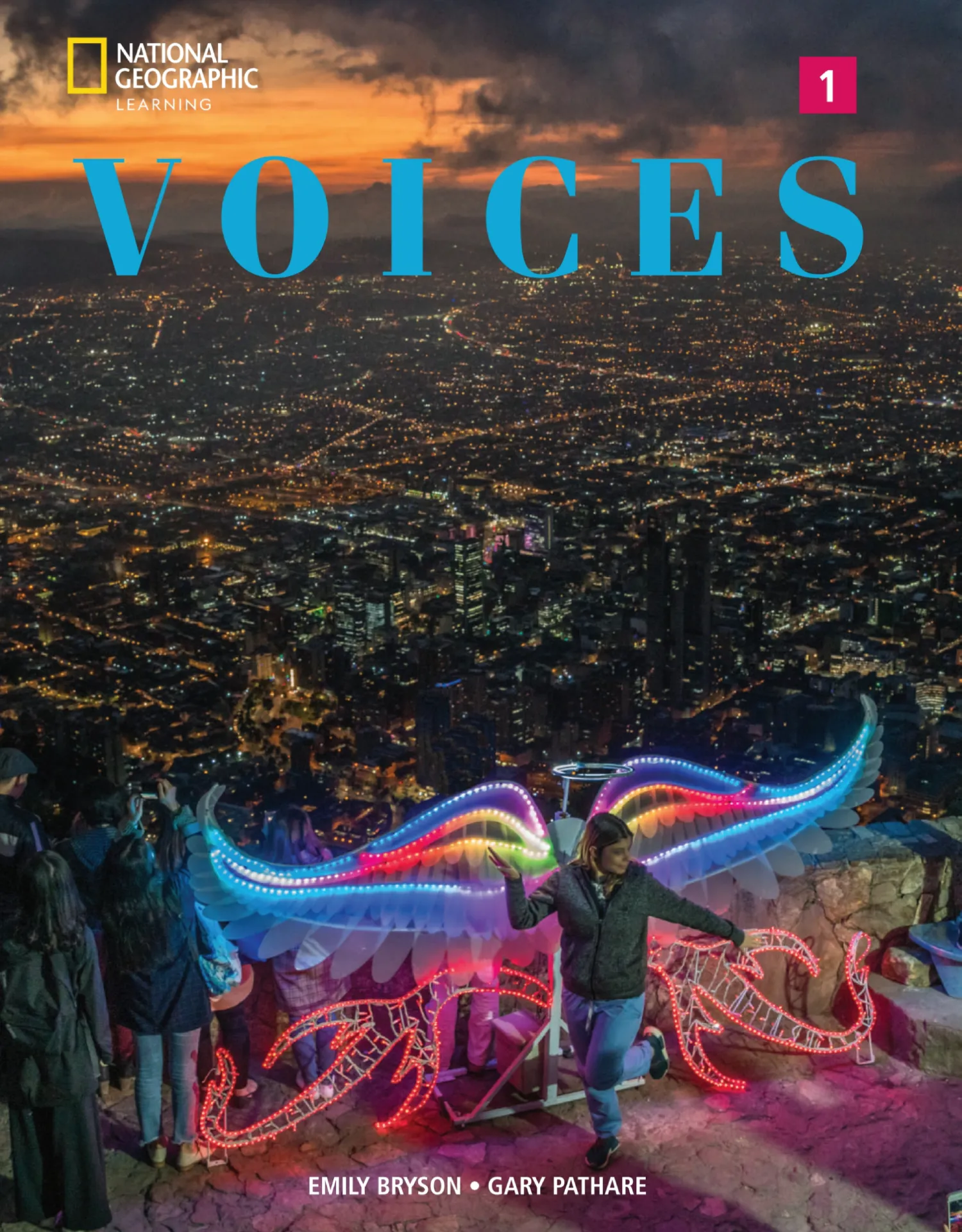
Voices 1 Student’s Book
Key Features of Voices American English
1. English for Global Communication
The course presents English as an international communication tool rather than a language belonging to only one country or culture. Learners encounter speakers, experiences, and viewpoints from different parts of the world, helping them become more comfortable with the diversity of real-world English communication.
This international orientation can help students develop greater awareness of how culture influences communication. It also prepares them to interact more effectively in multicultural classrooms, international workplaces, academic environments, travel situations, and online communities.
2. Real People and Meaningful Stories
National Geographic Learning is known for using real-world content, powerful photography, and stories about people, places, communities, and ideas. In Voices, this material provides more than visual decoration. It establishes a meaningful context for language learning.
Learners listen to and watch people discuss their lives, work, interests, challenges, and experiences. These voices provide relatable communication models and expose students to different ways of expressing ideas. Real-world stories also give learners something substantial to discuss, reducing the artificial feeling often associated with traditional language exercises.
3. Integrated Development of Language Skills
Listening, speaking, reading, and writing are developed together rather than taught as isolated subjects. A unit may begin with a visual prompt or conversation, move into vocabulary and grammar work, include a reading or video, and conclude with a speaking, writing, or project-based task.
This integrated structure reflects how language is used outside the classroom. A learner may need to read information, listen to another person, interpret the message, and then respond orally or in writing. Practicing these connections supports more flexible and transferable communication skills.
4. A Strong Focus on Speaking
Speaking is one of the defining strengths of the series. Students are given frequent opportunities to personalize language, exchange opinions, describe experiences, and complete practical communication tasks.
Activities generally move from controlled support to more independent production. Learners first notice useful language, practice it in a structured context, and then apply it to a more personal or open-ended situation. This progression can reduce speaking anxiety while gradually increasing fluency and independence.
5. Practical Pronunciation Development
The pronunciation syllabus emphasizes clarity and comprehensibility. Its purpose is not to make every learner sound exactly like a native speaker. Instead, students learn to produce language clearly enough to be understood in real communication.
Pronunciation work may address individual sounds, word stress, sentence stress, rhythm, connected speech, and intonation. These features also support listening comprehension because students become more aware of how spoken English changes in natural conversation.
This focus is particularly valuable in international contexts, where successful communication depends more on intelligibility than on copying a single accent.
6. Grammar and Vocabulary in Context
Although Voices has a strong communicative identity, it still provides a structured foundation in grammar and vocabulary. New language is normally introduced through meaningful situations before learners analyze form, meaning, and use.
Grammar is treated as a resource for communication. Learners are not simply asked to complete sentences; they are guided toward using grammatical structures to describe situations, tell stories, compare ideas, express possibilities, or explain opinions.
Vocabulary development similarly focuses on useful language connected to each unit theme. Students encounter words and expressions in context, practice common combinations, and reuse the language in speaking and writing tasks.
7. Critical Thinking and Personal Response
Many activities ask learners to go beyond locating information in a text. Students may evaluate an idea, compare alternatives, interpret another person’s viewpoint, support an opinion, or consider how they would respond in a particular situation.
These tasks encourage deeper engagement with both content and language. When students have a genuine reason to think and respond, communication becomes more purposeful. The result is a classroom in which English is used to explore ideas rather than merely display knowledge of language forms.
8. Mediation and Social Interaction
An important contemporary feature of Voices is its attention to mediation. In language education, mediation involves helping other people understand information, ideas, viewpoints, or situations. It may include summarizing a message, explaining information in simpler language, finding common ground, or helping a conversation move forward.
These skills are highly relevant to real-life communication. Learners frequently use English to connect people, interpret information, clarify misunderstandings, or collaborate with speakers from different linguistic backgrounds. By practicing mediation, students develop communication strategies that extend beyond traditional grammar and vocabulary exercises.
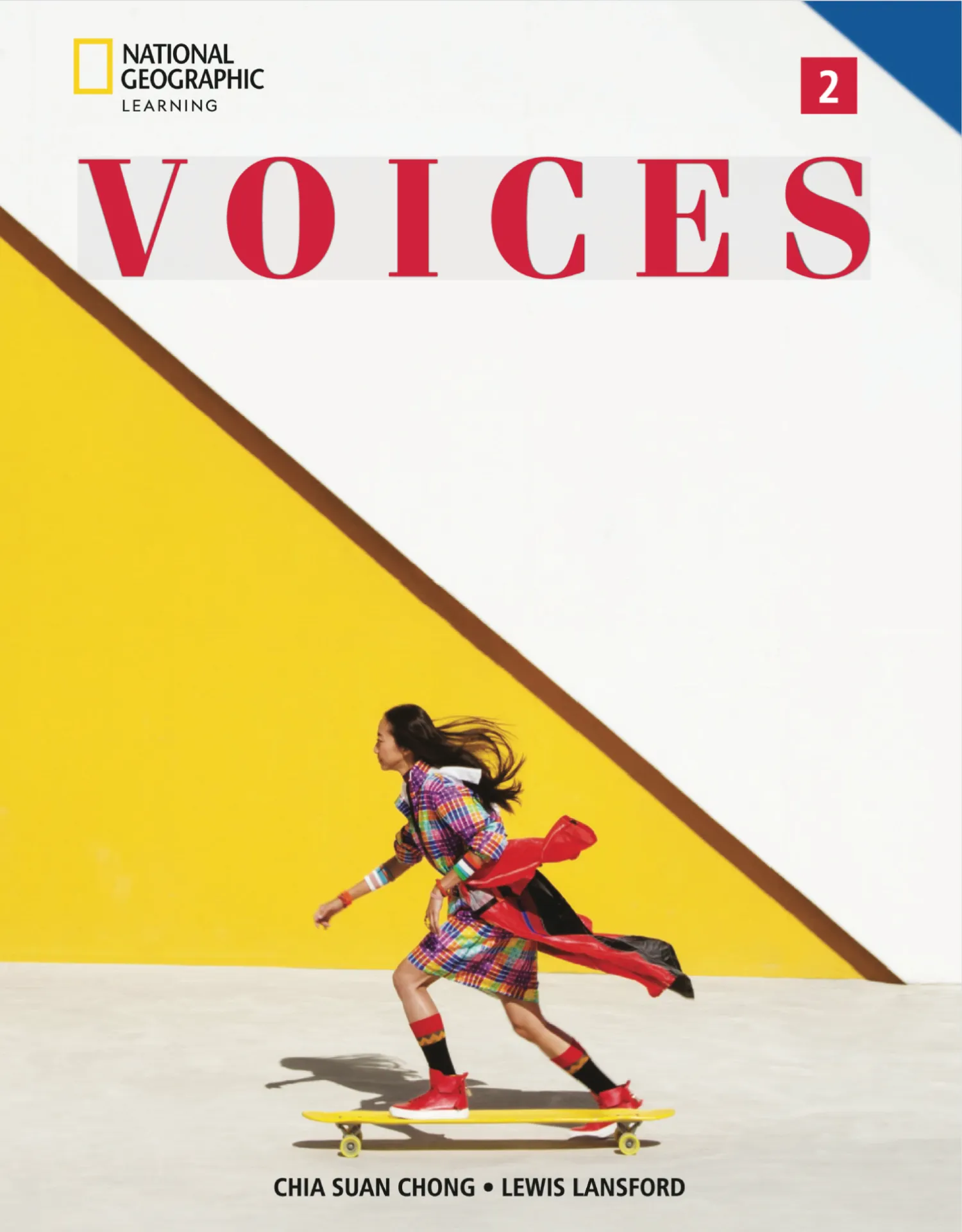
Voices 2 Student’s Book
Recurring Learning Strands
The course is supported by several recognizable pedagogical strands that contribute to the development of confident communication.
Real Voices
Real people provide varied and relatable models of spoken English. Learners observe how individuals communicate ideas, share experiences, and respond naturally in different contexts. This helps connect classroom language with authentic human communication.
My Voice
Personalization activities encourage learners to contribute their own ideas instead of repeating predetermined answers. Students connect unit topics with their experiences, preferences, communities, and future goals. This creates stronger engagement and gives language practice a clear personal purpose.
Clear Voices
Pronunciation and speaking support help learners become easier to understand. The emphasis on clear communication can build confidence and prepare students for conversations with people from a wide variety of language backgrounds.
Voices 3 Student’s Book
National Geographic Content in the Classroom
National Geographic photography and video give the course a strong visual identity. However, the educational value of this material goes beyond appearance. Images often serve as starting points for observation, prediction, discussion, vocabulary development, and critical thinking.
Visual storytelling can make complex themes more accessible, particularly for learners who need contextual support before reading or listening. It can also activate background knowledge, create curiosity, and encourage students to communicate before they have examined the main language focus of a lesson.
The subjects explored in the series connect English learning with the wider world. Depending on the level and unit, learners may discuss identity, relationships, work, technology, creativity, communities, travel, social behavior, cultural traditions, personal choices, or environmental issues.
Listening and Video-Based Learning
Audio and video play an important role throughout the program. Learners hear conversations, interviews, narratives, and other spoken texts that expose them to natural communication patterns. Carefully structured tasks guide students from general understanding to more detailed comprehension.
Video can be particularly effective because learners receive visual and situational information in addition to spoken language. Facial expressions, gestures, setting, and interaction all help students interpret meaning. These features also support classroom discussion and provide models for students’ own spoken production.
Teachers can use the media program before, during, or after the main lesson. A video may introduce a topic, provide comprehension practice, demonstrate language in use, or lead into a personalized speaking activity.
Writing Development
Writing tasks are connected to the language and themes introduced in each unit. Learners build the vocabulary, grammar, and organizational knowledge needed before completing a final written response.
At lower levels, writing support may focus on sentence formation, basic organization, and familiar personal topics. At higher levels, learners are expected to present more developed ideas, connect information logically, and communicate with greater precision.
Because writing is integrated with reading, listening, and discussion, students usually have both content and language available before they begin. This can make writing more manageable and reduce dependence on translation from the first language.
Voices 4 Student’s Book
A Seven-Level Learning Pathway from A1 to C1
The seven-level structure provides a gradual progression from basic communication to more sophisticated and independent language use.
- Beginning stages: Learners establish essential vocabulary, grammar, pronunciation, and everyday communication skills.
- Developing stages: Students expand their ability to describe experiences, exchange information, express opinions, and understand longer texts and conversations.
- Independent stages: Learners communicate with greater fluency, manage less predictable situations, and discuss a wider range of personal, social, and professional topics.
- Advanced stages: Students work with more complex ideas, nuanced language, extended discourse, and demanding speaking and writing tasks.
This continuous pathway can make curriculum planning easier for institutions that want to use one core series across several proficiency bands.
Course Components and Teaching Resources
The exact package may differ by country, institution, or purchasing format. However, the Voices American English program is supported by a broad range of print and digital materials.
Resources for Learners
- Student’s Book
- Workbook
- Student’s Book audio
- Workbook audio
- Student’s Book video
- Digital learning activities
- Vocabulary support
- Additional practice materials
Resources for Teachers
- Teacher’s Book and teaching notes
- Answer keys
- Audio and video scripts
- Assessment materials
- CEFR correlation documents
- Lesson resources and worksheets
- Projects and mediation activities
- Word lists
- Scope and sequence documents
- Pacing guides
- Professional development videos
This combination gives teachers flexibility when planning face-to-face, blended, or digitally supported courses. Assessment and curriculum documents can also help institutions maintain consistency across classes and teaching teams.
Voices 5 Student’s Book
Who Is Voices American English Suitable For?
The series is especially suitable for:
- Adult and young adult general English learners
- Language schools offering multi-level English programs
- Universities and colleges providing general communication courses
- Learners preparing to communicate in international environments
- Teachers who value visual, real-world, and discussion-based content
- Institutions seeking a structured CEFR-aligned course from A1 to C1
- Classes that need balanced work across all four language skills
- Learners who want to improve speaking confidence and pronunciation clarity
Benefits for English Learners
Voices American English offers several important benefits.
- It connects grammar and vocabulary with meaningful communication.
- It gives learners regular opportunities to express personal ideas.
- It builds listening confidence through varied audio and video input.
- It develops pronunciation for intelligible international communication.
- It introduces learners to different cultures and perspectives.
- It integrates critical thinking with language practice.
- It develops mediation and collaborative communication skills.
- It provides a clear long-term pathway from A1 to C1.
Benefits for Teachers and Institutions
Teachers benefit from a predictable lesson structure, clearly defined language aims, high-quality visual content, and a substantial range of support materials. These elements can reduce preparation time while still allowing teachers to adapt lessons to local needs.
For institutions, the seven-level structure supports continuity between courses. CEFR correlation, assessment resources, pacing guides, and scope-and-sequence documents can assist with placement, curriculum development, teacher coordination, and learning-outcome monitoring.
The variety of discussion, video, project, and personalization activities also allows the course to be used with different teaching styles. Lessons can be expanded for longer programs or selectively adapted for more intensive schedules.
Voices 6 Student’s Book
Important Teaching Considerations
Although the international content is one of the course’s major strengths, teachers should still connect themes to the local classroom. Some topics may be unfamiliar to learners, so additional background information or pre-teaching may occasionally be necessary.
Lower-level students may also need extra preparation before open-ended discussions. Teachers can improve participation by providing useful expressions, model responses, planning time, pair rehearsal, and clear task outcomes.
Because the series includes substantial visual and media content, schools should ensure that classrooms have suitable equipment and reliable access to the required digital resources. Teachers working without consistent internet access may need to prepare audio and video materials in advance.
How Voices Differs from Traditional English Courses
Many traditional courses are organized primarily around grammar sequences. Voices maintains systematic language development, but places greater emphasis on what learners can accomplish with that language.
A grammar point is therefore not the final objective. It becomes part of a larger communicative outcome: explaining a decision, comparing experiences, responding to another person, presenting an idea, or participating in a group task.
The series also gives unusual prominence to identity, personal response, intercultural awareness, mediation, and intelligible pronunciation. These areas reflect the realities of English as a global language and help prepare learners for communication beyond the classroom.
Why Voices Remains Relevant for Modern English Education
Modern language learners need to understand more than textbook conversations. They must interpret different accents, communicate across cultures, respond to unfamiliar ideas, collaborate with others, and express their own perspectives clearly.
Voices American English addresses these demands through a balanced combination of structured instruction and meaningful content. It develops accuracy without losing sight of fluency, and it promotes communication without neglecting grammar, vocabulary, reading, or writing.
Its most valuable contribution is the way it treats learners as participants in real communication. Students are not only learning about English; they are learning how to use English to understand people, share knowledge, and take part in a global community.
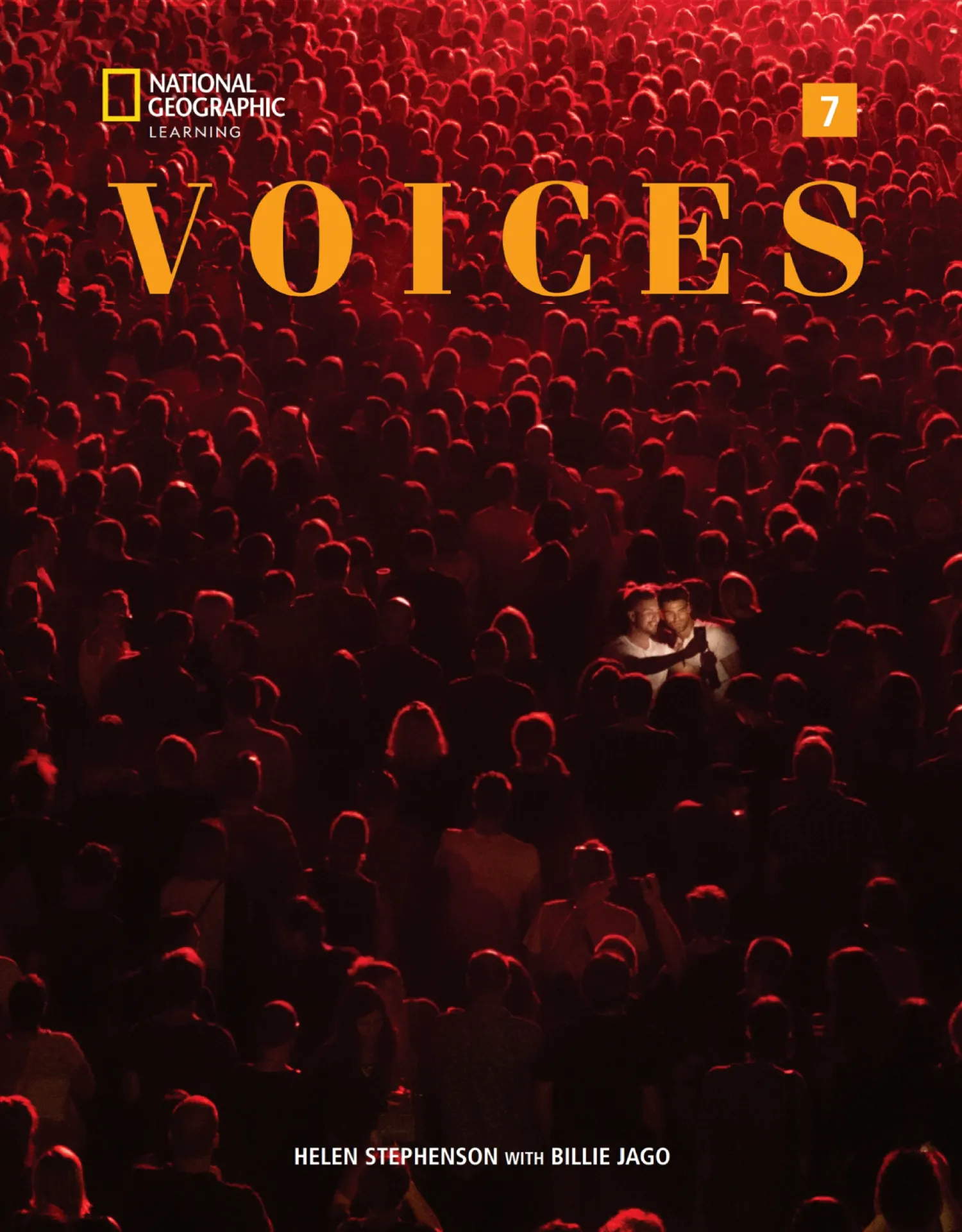
Voices 7 Student’s Book
Frequently Asked Questions
What is Voices American English?
Voices American English is a seven-level integrated-skills English course published by National Geographic Learning. It is designed primarily for adult and young adult learners and covers the CEFR A1 to C1 range.
Is Voices available in American English?
Yes. The series is available in an American English edition using American language conventions, vocabulary, spelling, and pronunciation models.
How many levels are included in Voices?
The complete program contains seven levels, providing a progressive learning pathway from elementary to advanced English.
What CEFR levels does Voices cover?
The full series covers CEFR levels A1 through C1.
Is Voices suitable for adult learners?
Yes. It was created specifically for adults and young adults studying general English in language schools, universities, colleges, and other educational settings.
Does Voices include pronunciation practice?
Yes. The course includes a practical pronunciation syllabus focused on clarity, intelligibility, and successful spoken communication.
Does the course include audio and video?
Yes. Audio and video are important parts of the learning program. Available resources may include Student’s Book audio, Workbook audio, and Student’s Book video, depending on the selected package.
Is Voices aligned with the CEFR?
Yes. The series follows a CEFR-based progression from A1 to C1, and CEFR correlation resources are available to support curriculum planning and course administration.
Can Voices be used for online or blended learning?
Yes. Its digital resources and selected Spark-supported packages make it suitable for classroom, blended, and digitally supported learning environments.
What makes Voices different from other general English courses?
Its distinctive features include international real-world content, strong speaking and pronunciation development, personal expression, cultural awareness, mediation activities, National Geographic photography, and communication-focused learning outcomes.
Final Evaluation
Voices American English by National Geographic Learning is a thoughtfully designed general English program for institutions and learners seeking more than routine language practice. Its seven-level A1–C1 pathway combines grammar, vocabulary, pronunciation, and integrated skills with global stories, personal response, critical thinking, and purposeful communication.
The course is particularly effective for learners who need to build a confident and intelligible voice in English. Through real people, culturally diverse perspectives, structured language support, and frequent opportunities for meaningful expression, Voices prepares students to use English not simply as an academic subject, but as a practical tool for connecting with the world.