

English Vocabulary in Use – All 4 Levels
Original price was: $28.$25Current price is: $25.
English Vocabulary in Use – All 4 Levels is a complete digital vocabulary collection covering CEFR A2 to C2. It includes four progressively graded books in PDF format and their accompanying audio resources.
The collection supports vocabulary development from practical everyday English to advanced collocations, idioms, word formation, nuance, and sophisticated language use.
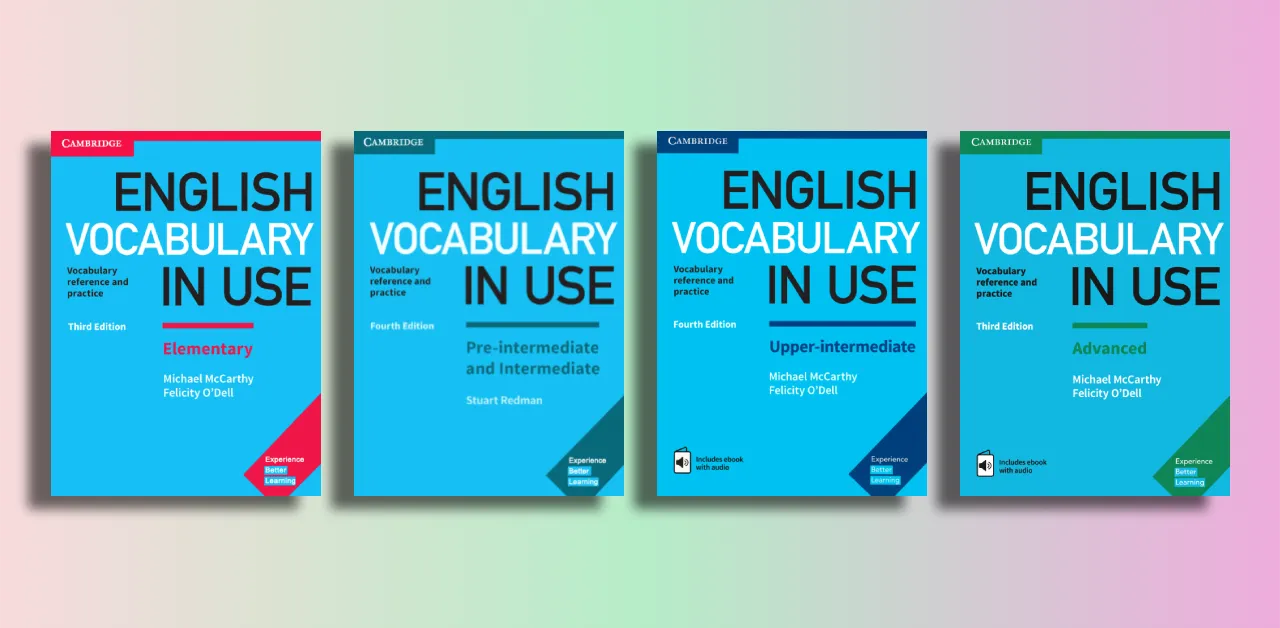
- Levels: Elementary, Pre-Intermediate & Intermediate, Upper Intermediate, and Advanced
- CEFR range: A2–C2
- Resources: Four complete PDF books and four audio packages
- Study modes: Self-study, classroom learning, tutoring, and revision
- File formats: PDF and ZIP
- Product type: Digital materials only
English Vocabulary in Use – All 4 Levels is a complete digital vocabulary collection covering the learning pathway from Elementary A2 to Advanced C1–C2.
The package includes four progressively graded vocabulary books in PDF format together with their accompanying audio resources. It is suitable for independent learners, teachers, tutors, schools, language centres, university students, and professionals seeking systematic vocabulary development.
Across the four levels, learners progress from essential everyday vocabulary to advanced collocations, idioms, phrasal verbs, word formation, register, nuance, and sophisticated language use.
Complete Vocabulary Pathway from A2 to C2
The collection includes the following four levels:
- Elementary – A2: Essential vocabulary for everyday communication and familiar situations.
- Pre-Intermediate & Intermediate – B1: Broader practical vocabulary for more confident communication.
- Upper Intermediate – B2: More precise language, collocations, phrasal verbs, word formation, and usage.
- Advanced – C1–C2: Sophisticated vocabulary, idioms, nuance, register, connotation, and advanced expression.
About English Vocabulary in Use
English Vocabulary in Use is a structured vocabulary-learning series designed to help learners expand their English through clear explanations, contextual examples, practical exercises, and independent review.
Vocabulary is presented through meaningful topics, common language functions, word relationships, collocations, usage patterns, and realistic communication contexts.
This method helps learners understand more than the basic definition of a word. Students also develop awareness of spelling, pronunciation, grammar, common combinations, register, nuance, and appropriate usage.
Collection Information
- Series: English Vocabulary in Use
- Number of levels: Four
- CEFR range: A2–C2
- Levels included: Elementary to Advanced
- Main focus: Systematic English vocabulary development
- Suitable for: Teen and adult English learners
- Study modes: Self-study, classroom learning, private tutoring, homework, and revision
- Product format: Digital PDF books and ZIP audio packages
Editions Included
This collection contains different editions according to the supplied level:
- Elementary: Third Edition
- Pre-Intermediate & Intermediate: Fourth Edition
- Upper Intermediate: Fourth Edition
- Advanced: Third Edition
The product should therefore be described as a multi-level collection containing both Third Edition and Fourth Edition materials rather than as a single-edition set.
Files Included
Elementary (A2)
English Vocabulary in Use 3ed Elementary Audio.zip
English Vocabulary in Use 3ed Elementary.pdf – Sample: Click
Pre-Intermediate & Intermediate (B1)
English Vocabulary in Use 4ed Pre-Intermediate & Intermediate Audio.zip
English Vocabulary in Use 4ed Pre-Intermediate & Intermediate.pdf – Sample: Click
Upper Intermediate (B2)
English Vocabulary in Use 4ed Upper Intermediate Audio.zip
English Vocabulary in Use 4ed Upper Intermediate.pdf – Sample: Click
Advanced (C1 – C2)
English Vocabulary in Use 3ed Advanced Audio.zip
English Vocabulary in Use 3ed Advanced.pdf – Sample: Click
Key Features
- Four progressively graded vocabulary levels
- Complete CEFR pathway from A2 to C2
- Four full vocabulary books in PDF format
- Four accompanying audio packages
- Clear explanations and contextual examples
- Topic-based vocabulary development
- Practice with collocations and natural word combinations
- Development of phrasal verbs, idioms, and fixed expressions
- Word formation and word-family practice
- Guidance on register, nuance, style, and appropriate usage
- Suitable for self-study and teacher-led lessons
Elementary – A2
The Elementary level helps learners establish a practical vocabulary foundation for everyday communication.
Students develop the language needed to discuss familiar areas such as people, family, homes, routines, food, clothing, travel, transport, shopping, health, weather, work, study, and leisure.
At this stage, learners focus on recognising common words, understanding basic meaning in context, improving spelling, and using vocabulary in short spoken and written exchanges.
The accompanying audio supports pronunciation, listening recognition, repetition, and review.
Pre-Intermediate & Intermediate – B1
The B1 level helps learners move beyond basic communication and express themselves with greater detail and confidence.
Students expand the language needed to describe experiences, discuss plans, compare alternatives, give reasons, express opinions, and understand the main ideas of conversations and texts.
The material also develops collocations, common expressions, phrasal verbs, word families, and vocabulary for broader everyday, educational, social, and professional situations.
Upper Intermediate – B2
The Upper Intermediate level develops more precise and flexible vocabulary for learners who already have a solid English foundation.
Students work with wider topic areas and develop greater awareness of collocations, word formation, phrasal verbs, synonyms, idiomatic expressions, register, and appropriate usage.
The level supports learners who need to explain complex ideas, compare viewpoints, participate in detailed discussions, and produce more varied spoken and written English.
Advanced – C1–C2
The Advanced level is designed for proficient learners who want to communicate with greater sophistication, precision, and stylistic control.
Learners explore subtle differences in meaning, connotation, register, tone, idiomatic language, metaphor, fixed expressions, advanced collocations, and complex word-formation patterns.
The material can support academic study, professional communication, formal writing, advanced reading, presentations, debates, and demanding examination preparation.
Vocabulary Progression Across the Four Levels
The collection offers a continuous vocabulary pathway rather than four unrelated books.
At A2, learners establish the high-frequency vocabulary needed for basic communication. At B1, they broaden their range and begin expressing more detailed ideas. At B2, they develop precision, natural word combinations, and flexibility. At C1–C2, they refine nuance, register, connotation, and sophisticated expression.
This progression makes the collection suitable for long-term study, course planning, revision, and placement-based learning.
Topic-Based Vocabulary Learning
Vocabulary is organised into practical and meaningful areas rather than presented as disconnected lists.
Depending on the level, learners may study language connected to daily life, relationships, personality, education, employment, travel, technology, media, culture, society, health, the environment, abstract ideas, academic study, and professional communication.
Topic-based organisation helps learners create connections between related words and apply them more easily in speaking, reading, listening, and writing.
Clear Explanations and Contextual Examples
The books provide explanations and examples that demonstrate how vocabulary functions in context.
This is important because knowing a translation alone does not show learners which preposition a word requires, which grammatical pattern it follows, how formal it is, or which words commonly combine with it.
Contextual examples help learners notice these patterns and reduce unnatural word choices.
Collocations and Natural English
Collocations are groups of words that frequently appear together. They are essential for natural and accurate English.
As learners progress through the collection, they develop greater awareness of verb-noun, adjective-noun, adverb-adjective, and other common word combinations.
Learning vocabulary as complete combinations also improves memory and helps learners retrieve language more quickly during communication.
Phrasal Verbs and Multi-Word Expressions
Phrasal verbs and multi-word expressions become increasingly important from the intermediate levels onwards.
The books help learners understand these expressions in context rather than attempting to translate each word separately.
Regular practice supports recognition in conversation, reading, films, presentations, online content, and everyday communication.
Idioms and Figurative Language
At higher levels, learners encounter idioms, fixed expressions, metaphorical language, and vocabulary whose meaning may not be immediately obvious.
Understanding this language improves comprehension of fluent conversation, media, journalism, literature, professional communication, and advanced written texts.
Word Formation and Word Families
Word formation helps learners expand their vocabulary efficiently by understanding relationships between different forms of a word.
Students develop awareness of prefixes, suffixes, roots, compounds, and connections between nouns, verbs, adjectives, and adverbs.
This knowledge supports reading comprehension, writing accuracy, examination tasks, and more flexible communication.
Register, Nuance, and Style
Intermediate and advanced learners need to understand how vocabulary changes according to audience, purpose, and context.
The collection helps students distinguish between formal, informal, neutral, spoken, written, academic, and professional language.
At advanced levels, learners also become more sensitive to connotation, emotional tone, strength, politeness, and subtle differences between similar expressions.
Audio for Every Level
Each level includes an accompanying audio package:
- Elementary Audio
- Pre-Intermediate & Intermediate Audio
- Upper Intermediate Audio
- Advanced Audio
The audio resources help learners connect written vocabulary with its spoken form.
They can be used for pronunciation, vocabulary recognition, repetition, word stress, listening practice, dictation, shadowing, and independent review.
Skills Supported
Listening
A broader vocabulary helps learners recognise words more quickly and understand spoken English more efficiently.
The audio resources add regular exposure to spoken vocabulary and support listening development across all four levels.
Speaking
Learners progress from using basic everyday words to selecting precise, nuanced, and context-appropriate language.
Vocabulary from each unit can be applied in interviews, role plays, discussions, presentations, debates, and personal responses.
Reading
Greater vocabulary knowledge helps learners understand texts more efficiently and rely less heavily on dictionaries or translation.
The collection supports progression from short everyday texts to detailed articles, reports, academic writing, literature, and professional documents.
Writing
The books help learners develop the vocabulary required for messages, emails, descriptions, stories, reviews, articles, reports, essays, proposals, and formal correspondence.
Higher levels also support more precise word choice, register, cohesion, and stylistic control.
Pronunciation
The accompanying audio enables learners to hear vocabulary, repeat it, practise word stress, and connect written forms with spoken pronunciation.
Benefits of Choosing All Four Levels
The complete collection allows learners to continue using a consistent vocabulary-learning approach as their English develops.
Teachers and language centres can select the appropriate book for different classes, while individual learners can begin at their current level and progress through the complete pathway.
The collection is also useful for revision. Advanced learners can return to lower levels to identify gaps in high-frequency vocabulary, while intermediate students can explore higher-level materials for additional challenge.
Suitable for Self-Study
The series is particularly suitable for independent learning because each unit focuses on a manageable vocabulary area.
Learners can study the presentation, examine the examples, listen to the audio, complete the exercises, record useful expressions, and return to the material for spaced review.
Short, regular sessions are generally more effective than attempting to memorise large lists of words in one sitting.
Suitable for Classroom and Tutoring Use
Teachers and tutors can use individual units to support a general English course, introduce vocabulary before a reading or discussion, prepare students for writing tasks, or address specific language gaps.
The materials can also be adapted for pair work, quizzes, vocabulary games, pronunciation practice, dictation, homework, revision, presentations, and debates.
Suggested Study Method
- Select the appropriate level: Begin with the book that matches the learner’s current ability.
- Choose a relevant unit: Select a topic connected to current needs or interests.
- Preview the vocabulary: Separate familiar language from genuinely new items.
- Study the explanations: Focus on meaning, grammar, spelling, register, and usage.
- Analyse the examples: Notice collocations, prepositions, and sentence patterns.
- Listen to the audio: Pay attention to pronunciation, stress, and recognition.
- Repeat aloud: Practise phrases and complete examples rather than isolated words.
- Complete the exercises: Retrieve and apply the vocabulary actively.
- Create personal examples: Connect new language with personal study, work, or experiences.
- Review regularly: Return to difficult vocabulary after several days and again after several weeks.
Who Is This Collection For?
- English learners studying from CEFR A2 to C2
- Elementary, intermediate, upper-intermediate, and advanced students
- Independent learners and self-study students
- English teachers and private tutors
- Language schools and training centres
- University students developing academic vocabulary
- Professionals using English for international communication
- Learners preparing for more advanced English courses or examinations
File Formats and Compatibility
- All four books are supplied in PDF format.
- All four audio collections are supplied in ZIP archives.
- A compatible PDF reader is required to open the books.
- ZIP extraction software may be required before accessing the audio files.
- A compatible media player is required to play the recordings.
- Compatibility may vary depending on the device, operating system, browser, and installed applications.
Frequently Asked Questions
How many levels are included?
The collection includes four levels: Elementary, Pre-Intermediate & Intermediate, Upper Intermediate, and Advanced.
What CEFR range does the collection cover?
The complete collection covers CEFR A2 to C2.
Which editions are included?
Elementary and Advanced are supplied as Third Edition files. Pre-Intermediate & Intermediate and Upper Intermediate are supplied as Fourth Edition files.
Are all four complete books included?
Yes. One complete PDF book is included for each level.
Is audio included for every level?
Yes. One accompanying audio package is included for each of the four levels.
Is a separate Workbook included?
No separate Workbook file is listed for any level.
Is a Teacher’s Book included?
No separate Teacher’s Book file is listed.
Are separate answer keys included?
No standalone answer-key files are listed. Please refer to the contents of each included book for any answer or reference sections it may contain.
Can learners begin with any level?
Yes. Learners should begin with the level that best matches their current vocabulary and overall English ability.
Can the collection be used for self-study?
Yes. The books and accompanying audio are suitable for independent learning, systematic revision, and guided self-study.
Can teachers use the collection in class?
Yes. Teachers can select individual units for vocabulary presentation, listening practice, speaking preparation, writing support, homework, and revision.
Is this a physical collection?
No. This is a digital product containing PDF books and ZIP audio packages. No printed books, physical CDs, or other physical items will be shipped.
A Complete Vocabulary Journey from A2 to C2
English Vocabulary in Use – All 4 Levels provides a structured pathway for learners who want to develop vocabulary continuously from Elementary to Advanced English.
Through clear explanations, contextual examples, collocations, phrasal verbs, idioms, word formation, usage guidance, exercises, and accompanying audio, the collection supports stronger listening, speaking, reading, writing, pronunciation, accuracy, and fluency.
For learners, teachers, tutors, schools, university students, and professionals seeking a complete English Vocabulary in Use PDF and audio collection from A2 to C2, this four-level package offers a flexible resource for long-term vocabulary development.
Important: This product contains digital files only. Please review the included levels, editions, file list, and compatibility information before purchasing.
| Name | Price | Buy |
|---|---|---|
| English Vocabulary in Use Elementary A2 PDF & Audio | $7 | |
| English Vocabulary in Use B1 PDF & Audio | $7 | |
| English Vocabulary in Use Upper Intermediate B2 PDF & Audio | $7 | |
| English Vocabulary in Use Advanced C1–C2 PDF & Audio | $7 | |
| English Vocabulary in Use – All 4 Levels | Original price was: $28.$25Current price is: $25. |
Related products
Uncategorized
Uncategorized

Uncategorized


Uncategorized

Uncategorized
Uncategorized