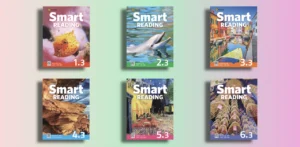
Smart Reading (PDFs, Resources)
Level 1 (Pre A1)
Smart Reading 1.1 (Pre A1) (30 Words)
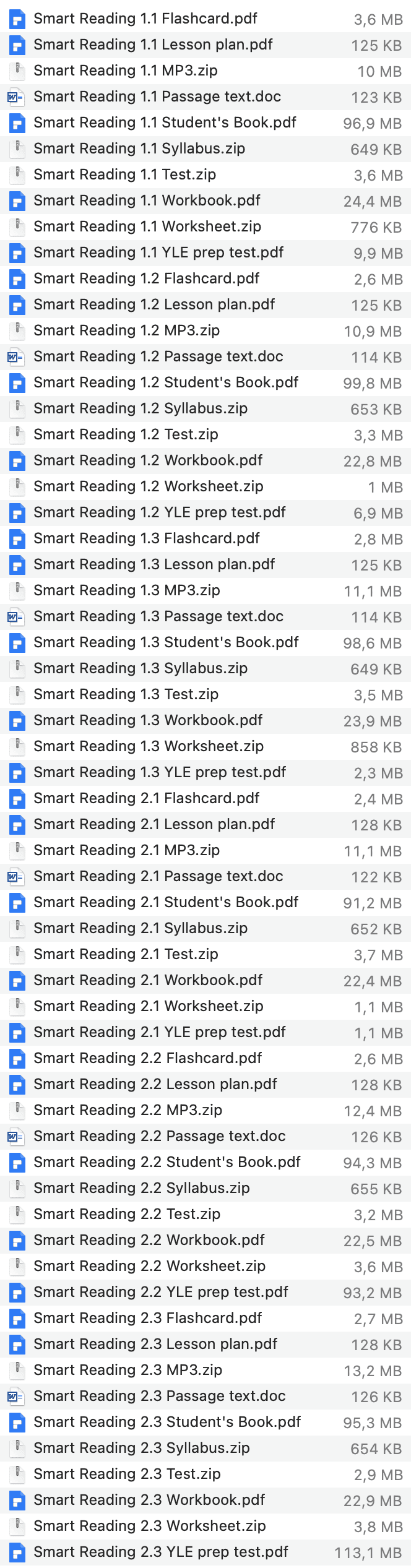
Smart Reading 1.1 Flashcard.pdf
Smart Reading 1.1 Lesson plan.pdf
Smart Reading 1.1 MP3.zip
Smart Reading 1.1 Passage text.doc
Smart Reading 1.1 Student’s Book.pdf – Sample: Click
Smart Reading 1.1 Syllabus.zip
Smart Reading 1.1 Test.zip
Smart Reading 1.1 Workbook.pdf – Sample: Click
Smart Reading 1.1 Worksheet.zip
Smart Reading 1.1 YLE prep test.pdf
Smart Reading 1.2 (Pre A1) (40 Words)
Smart Reading 1.2 Flashcard.pdf
Smart Reading 1.2 Lesson plan.pdf
Smart Reading 1.2 MP3.zip
Smart Reading 1.2 Passage text.doc
Smart Reading 1.2 Student’s Book.pdf – Sample: Click
Smart Reading 1.2 Syllabus.zip
Smart Reading 1.2 Test.zip
Smart Reading 1.2 Workbook.pdf – Sample: Click
Smart Reading 1.2 Worksheet.zip
Smart Reading 1.2 YLE prep test.pdf
Smart Reading 1.3 (Pre A1) (45 Words)
Smart Reading 1.3 Flashcard.pdf
Smart Reading 1.3 Lesson plan.pdf
Smart Reading 1.3 MP3.zip
Smart Reading 1.3 Passage text.doc
Smart Reading 1.3 Student’s Book.pdf – Sample: Click
Smart Reading 1.3 Syllabus.zip
Smart Reading 1.3 Test.zip
Smart Reading 1.3 Workbook.pdf – Sample: Click
Smart Reading 1.3 Worksheet.zip
Smart Reading 1.3 YLE prep test.pdf
Level 2 (A1)
Smart Reading 2.1 (Pre A1 / A1) (50 Words)
Smart Reading 2.1 Flashcard.pdf
Smart Reading 2.1 Lesson plan.pdf
Smart Reading 2.1 MP3.zip
Smart Reading 2.1 Passage text.doc
Smart Reading 2.1 Student’s Book.pdf – Sample: Click
Smart Reading 2.1 Syllabus.zip
Smart Reading 2.1 Test.zip
Smart Reading 2.1 Workbook.pdf – Sample: Click
Smart Reading 2.1 Worksheet.zip
Smart Reading 2.1 YLE prep test.pdf
Smart Reading 2.2 (Pre A1 / A1) (60 Words)
Smart Reading 2.2 Flashcard.pdf
Smart Reading 2.2 Lesson plan.pdf
Smart Reading 2.2 MP3.zip
Smart Reading 2.2 Passage text.doc
Smart Reading 2.2 Student’s Book.pdf – Sample: Click
Smart Reading 2.2 Syllabus.zip
Smart Reading 2.2 Test.zip
Smart Reading 2.2 Workbook.pdf – Sample: Click
Smart Reading 2.2 Worksheet.zip
Smart Reading 2.2 YLE prep test.pdf
Smart Reading 2.3 (Pre A1 / A1) (65 Words)
Smart Reading 2.3 Flashcard.pdf
Smart Reading 2.3 Lesson plan.pdf
Smart Reading 2.3 MP3.zip
Smart Reading 2.3 Passage text.doc
Smart Reading 2.3 Student’s Book.pdf – Sample: Click
Smart Reading 2.3 Syllabus.zip
Smart Reading 2.3 Test.zip
Smart Reading 2.3 Workbook.pdf – Sample: Click
Smart Reading 2.3 Worksheet.zip
Smart Reading 2.3 YLE prep test.pdf
Level 3 (A2)
Smart Reading 3.1 (A1) (70 Words)
Smart Reading 3.1 Flashcard.pdf
Smart Reading 3.1 Lesson plan.pdf
Smart Reading 3.1 MP3.zip
Smart Reading 3.1 Passage text.docx
Smart Reading 3.1 Student’s Book.pdf – Sample: Click
Smart Reading 3.1 Syllabus.zip
Smart Reading 3.1 Test.zip
Smart Reading 3.1 Workbook.pdf – Sample: Click
Smart Reading 3.1 Worksheet.zip
Smart Reading 3.1 YLE prep test.pdf
Smart Reading 3.2 (A1) (80 Words)
Smart Reading 3.2 Flashcard.pdf
Smart Reading 3.2 Lesson plan.pdf
Smart Reading 3.2 MP3.zip
Smart Reading 3.2 Passage text.docx
Smart Reading 3.2 Student’s Book.pdf – Sample: Click
Smart Reading 3.2 Syllabus.zip
Smart Reading 3.2 Test.zip
Smart Reading 3.2 Workbook.pdf – Sample: Click
Smart Reading 3.2 Worksheet.zip
Smart Reading 3.2 YLE prep test.pdf
Smart Reading 3.3 (A1) (90 Words)
Smart Reading 3.3 Flashcard.pdf
Smart Reading 3.3 Lesson plan.pdf
Smart Reading 3.3 MP3.zip
Smart Reading 3.3 Passage text.docx
Smart Reading 3.3 Student’s Book.pdf – Sample: Click
Smart Reading 3.3 Syllabus.zip
Smart Reading 3.3 Test.zip
Smart Reading 3.3 Workbook.pdf – Sample: Click
Smart Reading 3.3 Worksheet.zip
Smart Reading 3.3 YLE prep test.pdf
Level 4 (A2)
Smart Reading 4.1 (A1) (100 Words)
Smart Reading 4.1 Lesson plan.pdf
Smart Reading 4.1 MP3.zip
Smart Reading 4.1 Passage text.docx
Smart Reading 4.1 Student’s Book.pdf – Sample: Click
Smart Reading 4.1 Syllabus.zip
Smart Reading 4.1 Test.zip
Smart Reading 4.1 Workbook.pdf – Sample: Click
Smart Reading 4.1 Worksheet.zip
Smart Reading 4.1 YLE prep test.pdf
Smart Reading 4.2 (A1) (110 Words)
Smart Reading 4.2 Lesson plan.pdf
Smart Reading 4.2 MP3.zip
Smart Reading 4.2 Passage text.docx
Smart Reading 4.2 Student’s Book.pdf – Sample: Click
Smart Reading 4.2 Syllabus.zip
Smart Reading 4.2 Test.zip
Smart Reading 4.2 Workbook.pdf – Sample: Click
Smart Reading 4.2 Worksheet.zip
Smart Reading 4.2 YLE prep test.pdf
Smart Reading 4.3 (A1) (120 Words)
Smart Reading 4.3 Lesson plan.pdf
Smart Reading 4.3 MP3.zip
Smart Reading 4.3 Passage text.docx
Smart Reading 4.3 Student’s Book.pdf – Sample: Click
Smart Reading 4.3 Syllabus.zip
Smart Reading 4.3 Test.zip
Smart Reading 4.3 Workbook.pdf – Sample: Click
Smart Reading 4.3 Worksheet.zip
Smart Reading 4.3 YLE prep test.pdf
Level 5 (A2)
Smart Reading 5.1 (A2) (130 Words)
Smart Reading 5.1 Lesson plan.pdf
Smart Reading 5.1 MP3.zip
Smart Reading 5.1 Passage text.docx
Smart Reading 5.1 Student’s Book.pdf – Sample: Click
Smart Reading 5.1 Syllabus.zip
Smart Reading 5.1 Test.zip
Smart Reading 5.1 Workbook.pdf – Sample: Click
Smart Reading 5.1 Worksheet.zip
Smart Reading 5.1 YLE prep test.pdf
Smart Reading 5.2 (A2) (150 Words)
Smart Reading 5.2 Lesson plan.pdf
Smart Reading 5.2 MP3.zip
Smart Reading 5.2 Passage text.docx
Smart Reading 5.2 Student’s Book.pdf – Sample: Click
Smart Reading 5.2 Syllabus.zip
Smart Reading 5.2 Test.zip
Smart Reading 5.2 Workbook.pdf – Sample: Click
Smart Reading 5.2 Worksheet.zip
Smart Reading 5.2 YLE prep test.pdf
Smart Reading 5.3 (A2) (170 Words)
Smart Reading 5.3 Lesson plan.pdf
Smart Reading 5.3 MP3.zip
Smart Reading 5.3 Passage text.docx
Smart Reading 5.3 Student’s Book.pdf – Sample: Click
Smart Reading 5.3 Syllabus.zip
Smart Reading 5.3 Test.zip
Smart Reading 5.3 Workbook.pdf – Sample: Click
Smart Reading 5.3 Worksheet.zip
Smart Reading 5.3 YLE prep test.pdf
Level 6 (A2)
Smart Reading 6.1 (A2) (180 Words)
Smart Reading 6.1 Lesson plan.pdf
Smart Reading 6.1 MP3.zip
Smart Reading 6.1 Passage text.docx
Smart Reading 6.1 Student’s Book.pdf – Sample: Click
Smart Reading 6.1 Syllabus.zip
Smart Reading 6.1 Test.zip
Smart Reading 6.1 Workbook.pdf – Sample: Click
Smart Reading 6.1 Worksheet.zip
Smart Reading 6.1 YLE prep test.pdf
Smart Reading 6.2 (A2) (200 Words)
Smart Reading 6.2 Lesson plan.pdf
Smart Reading 6.2 MP3.zip
Smart Reading 6.2 Passage text.docx
Smart Reading 6.2 Student’s Book.pdf – Sample: Click
Smart Reading 6.2 Syllabus.zip
Smart Reading 6.2 Test.zip
Smart Reading 6.2 Workbook.pdf – Sample: Click
Smart Reading 6.2 Worksheet.zip
Smart Reading 6.2 YLE prep test.pdf
Smart Reading 6.3 (A2) (220 Words)
Smart Reading 6.3 Lesson plan.pdf
Smart Reading 6.3 MP3.zip
Smart Reading 6.3 Passage text.docx
Smart Reading 6.3 Student’s Book.pdf – Sample: Click
Smart Reading 6.3 Syllabus.zip
Smart Reading 6.3 Test.zip
Smart Reading 6.3 Workbook.pdf – Sample: Click
Smart Reading 6.3 Worksheet.zip
Smart Reading 6.3 YLE prep test.pdf
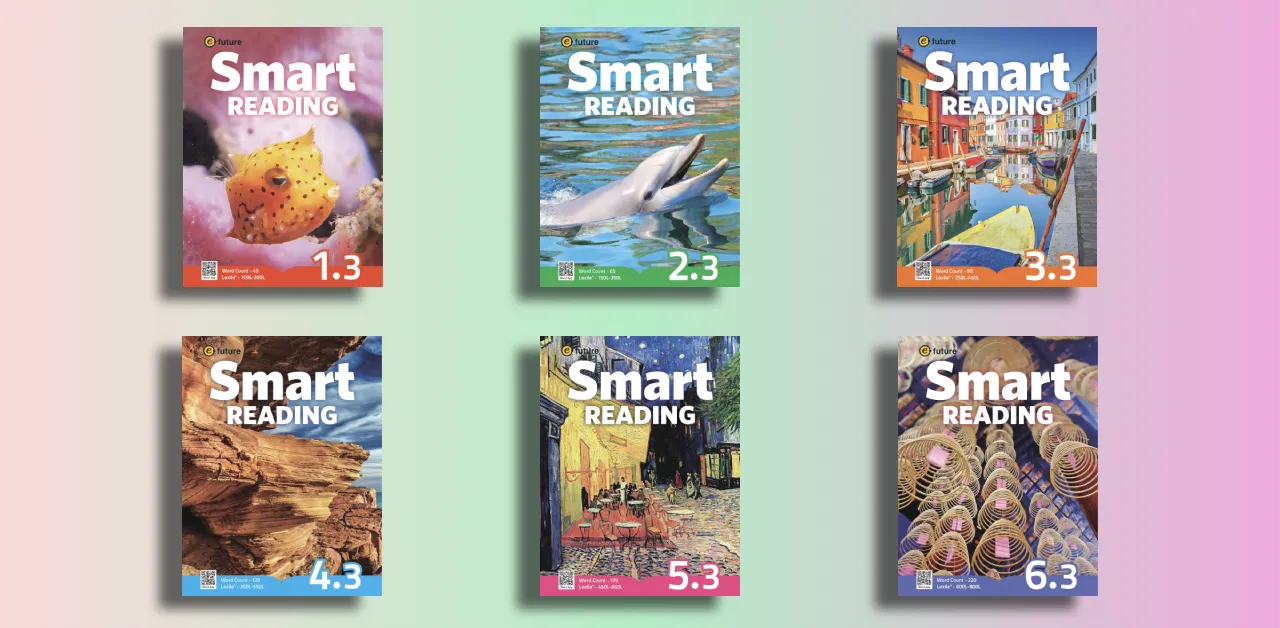
Overview of the “Smart Reading”
Contents
- 1 Overview of the “Smart Reading”
- 2 What Is Smart Reading?
- 3 Smart Reading Level Structure
- 4 A Gradual Approach to Reading Development
- 5 Fiction and Nonfiction Reading
- 6 Paired Texts and Thematic Learning
- 7 Vocabulary Development in Context
- 8 Reading Comprehension Skills
- 9 The Role of Visual Learning
- 10 Audio Support and Reading Fluency
- 11 A Typical Smart Reading Learning Cycle
- 12 Teaching and Learning Resources
- 13 Educational Strengths of Smart Reading
- 14 Who Is Smart Reading For?
- 15 How to Choose the Correct Starting Level
- 16 How Teachers Can Use Smart Reading Effectively
- 17 Smart Reading as Part of a Wider Curriculum
- 18 Why Reading Fluency Matters
- 19 Is Smart Reading a Good Choice?
- 20 Frequently Asked Questions
- 21 Final Evaluation
| ✅ Coursebook: | Smart Reading |
| ✅ Publisher: | eFuture |
| ✅ Levels: | Pre A1, A1, A2 |
| ✅ For: | Primary School |
| ✅ Skill: | Reading |
| ✅ Publication year: | 2025 |
Smart Reading by eFuture is a systematic English reading program designed to help young learners become fluent, accurate, and confident readers. Across six carefully graded levels and 18 books, the series develops vocabulary, reading comprehension, sentence awareness, and critical thinking through engaging fiction and nonfiction texts.
The program begins with short passages of approximately 30 words and gradually progresses to texts of around 220 words. This measured increase allows learners to strengthen their reading ability without facing sudden jumps in language complexity.
Covering approximately CEFR Pre-A1 to A2, Smart Reading is particularly suitable for elementary-age learners studying English as a foreign or additional language. Its structured progression, school-related themes, visual support, audio materials, and focused comprehension practice make it useful for classrooms, language centers, tutoring programs, and guided learning at home.
What Is Smart Reading?
Smart Reading is an elementary English reading series published by eFuture, an educational publisher specializing in materials for young English language learners.
The complete program contains six main levels:
- Smart Reading 1
- Smart Reading 2
- Smart Reading 3
- Smart Reading 4
- Smart Reading 5
- Smart Reading 6
Each level is divided into three books, creating a total of 18 books from Smart Reading 1-1 to Smart Reading 6-3.
Rather than asking beginners to move immediately from individual sentences to long passages, the series introduces reading in small and manageable stages. Passage length, vocabulary load, sentence structure, text organization, and comprehension demands become progressively more challenging as learners advance.
The main goal is not simply to help children pronounce written words. Smart Reading aims to develop complete readers who can understand information, identify important ideas, connect details, interpret visual information, and respond meaningfully to a text.
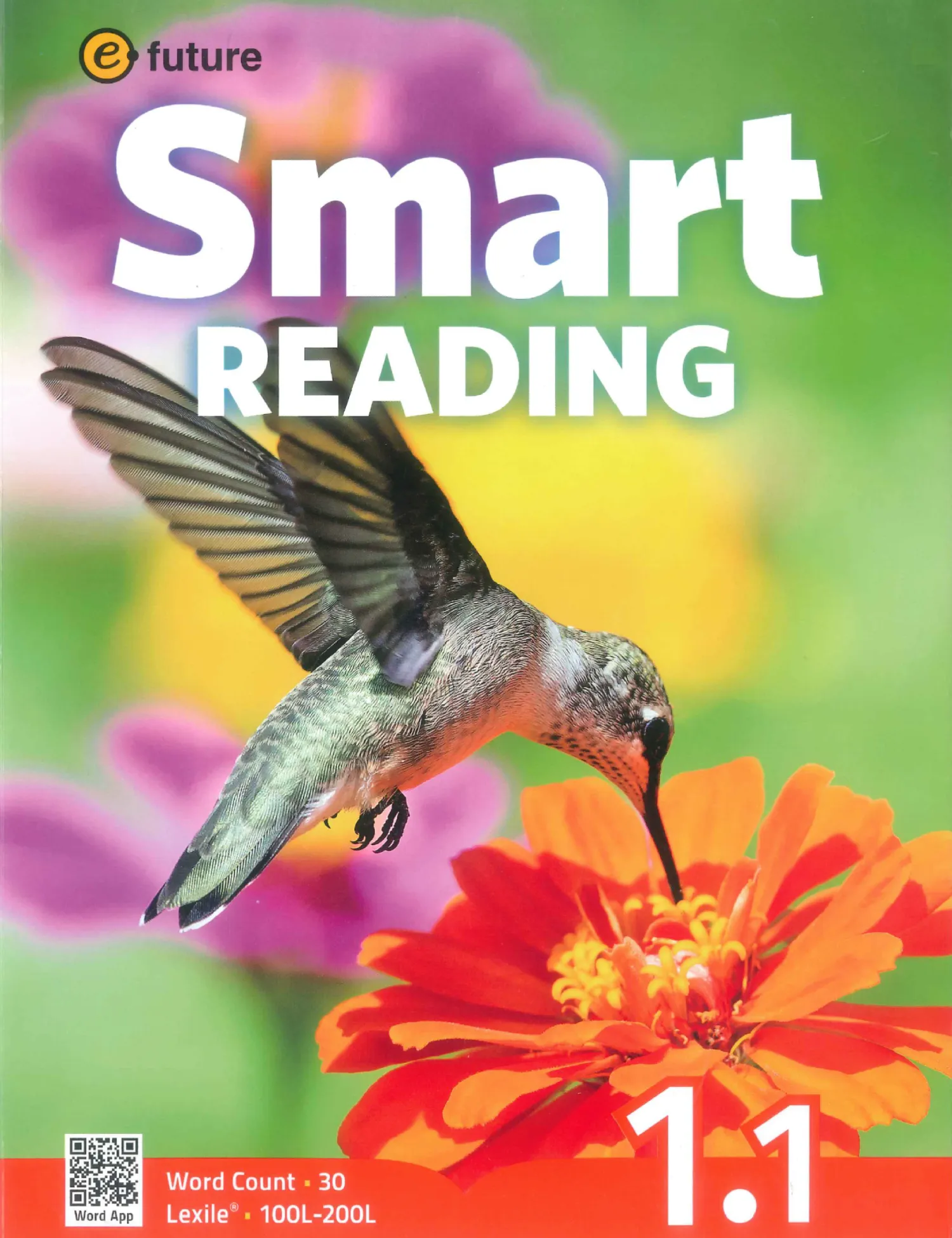
Smart Reading 1.1 Student’s Book
Smart Reading Level Structure
One of the strongest features of the series is its transparent progression. The approximate passage length increases across the program as follows:
| Level | Books | Approximate Passage Length |
|---|---|---|
| Smart Reading 1 | 1-1, 1-2, 1-3 | 30–45 words |
| Smart Reading 2 | 2-1, 2-2, 2-3 | 50–65 words |
| Smart Reading 3 | 3-1, 3-2, 3-3 | 70–90 words |
| Smart Reading 4 | 4-1, 4-2, 4-3 | 100–120 words |
| Smart Reading 5 | 5-1, 5-2, 5-3 | 130–170 words |
| Smart Reading 6 | 6-1, 6-2, 6-3 | 180–220 words |
The series broadly spans CEFR Pre-A1 to A2. The early books are intended for learners beginning to read short English texts, while the upper levels are appropriate for students ready to process longer passages, broader vocabulary, and more demanding comprehension tasks.
Teachers should select a starting level according to a learner’s actual reading ability rather than age alone. A student may have strong speaking skills but limited reading experience, or may recognize many words without fully understanding connected texts.
A Gradual Approach to Reading Development
Young English learners need more than exposure to written texts. They require carefully controlled practice that helps them coordinate several reading processes at the same time.
To understand a passage successfully, a learner must recognize words, process sentence patterns, connect ideas across sentences, remember important information, and interpret the writer’s purpose. If too many of these elements are unfamiliar, reading can become slow and frustrating.
Smart Reading addresses this challenge through gradual progression. Early texts are brief and highly accessible. As learners become more experienced, passages grow longer and include a wider range of structures, topics, and organizational patterns.
This design supports reading fluency because students repeatedly work with texts at an achievable level. Instead of treating reading as a test of endurance, the series presents it as a skill that can be strengthened through structured and meaningful practice.
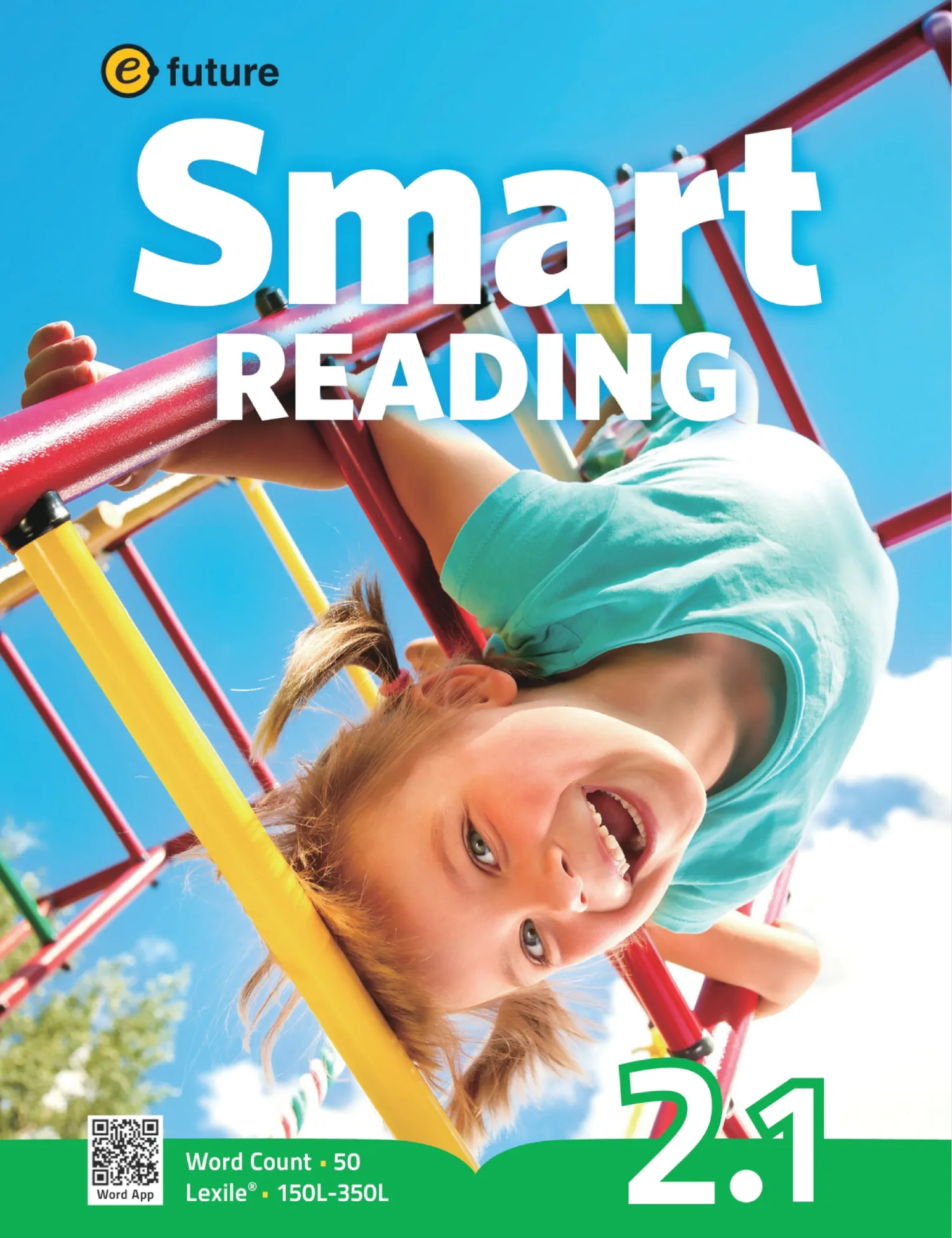
Smart Reading 2.1 Student’s Book
Fiction and Nonfiction Reading
Smart Reading includes both fiction and nonfiction passages. This balance is educationally important because the two text types require partly different ways of reading.
Fiction Reading Skills
Fiction texts help learners understand:
- Characters and their actions
- Setting and sequence
- Problems and solutions
- Feelings and motivations
- Cause-and-effect relationships within stories
Nonfiction Reading Skills
Nonfiction texts help learners work with:
- Facts and explanations
- Topic-specific vocabulary
- Main ideas and supporting details
- Classification and comparison
- Processes, systems, and real-world information
By reading across both categories, students learn that different texts are organized for different purposes. They begin to recognize whether a passage is telling a story, explaining a concept, describing an object, presenting information, or exploring a real-world issue.
The subject matter is connected to themes relevant to elementary learners and may include science, nature, social studies, daily life, technology, health, culture, and the environment.
This cross-curricular dimension makes reading more meaningful. Students are not learning English in isolation; they are using English to understand the wider world.
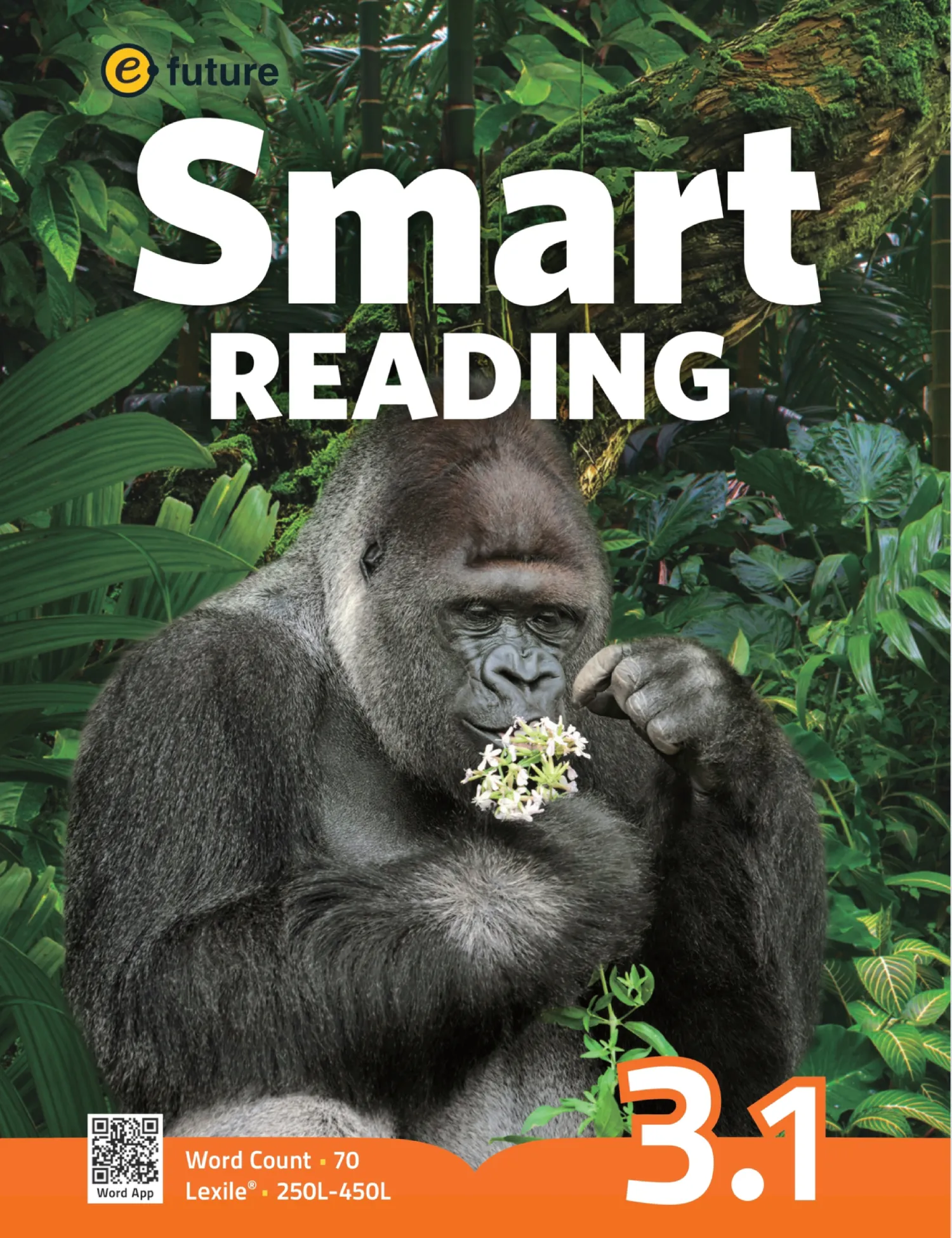
Smart Reading 3.1 Student’s Book
Paired Texts and Thematic Learning
A notable feature of Smart Reading is the use of related passages built around a shared theme.
When two texts explore connected ideas, learners have opportunities to encounter important vocabulary more than once and examine a topic from different perspectives. The second passage does not simply repeat the first. Instead, it may extend the topic, introduce another text type, or encourage learners to make meaningful connections.
This approach offers several educational advantages.
First, repeated exposure strengthens vocabulary retention. A word encountered across meaningful contexts is more likely to become part of a learner’s usable language.
Second, paired texts support deeper thinking. Learners can identify similarities and differences, connect new information to previous knowledge, and discuss how two passages relate to one another.
Third, thematic organization creates continuity. Lessons feel connected instead of presenting students with an unrelated collection of texts and exercises.
Vocabulary Development in Context
Vocabulary knowledge is one of the most important foundations of successful reading comprehension. Students cannot understand a passage efficiently when too many words are unfamiliar.
Smart Reading prepares learners for each text through focused work with key vocabulary. Words are introduced in relation to the passage rather than presented as isolated items for memorization.
This allows students to develop several kinds of vocabulary knowledge:
- The basic meaning of a word
- Its pronunciation
- Its written form
- The way it functions in a sentence
- The situations in which it is commonly used
- Its relationship to the lesson topic
After reading, vocabulary activities provide further review. Companion digital resources can also give learners opportunities to revisit words and sentences through quiz-style practice.
This combination of preparation, contextual exposure, and retrieval practice is more effective than relying on one-time memorization.
Smart Reading 4.1 Student’s Book
Reading Comprehension Skills
The comprehension tasks in Smart Reading move beyond simple word recognition. Learners are guided to understand how meaning is constructed within a text.
Depending on the level and passage, activities may focus on skills such as:
- Identifying the main idea
- Locating supporting details
- Understanding sequence
- Recognizing cause and effect
- Comparing people, objects, or ideas
- Interpreting information from context
- Understanding relationships between sentences
- Organizing information visually
- Summarizing important content
- Responding to a text with personal ideas
At lower levels, students may rely more heavily on pictures, key words, and direct information. At higher levels, they are increasingly expected to organize information, connect ideas, and distinguish essential points from minor details.
This progression is important because reading comprehension should not be reduced to answering a few factual questions. Effective readers construct a coherent understanding of the complete text.
The Role of Visual Learning
Pictures and graphic organizers are especially valuable for young learners who are still developing the language required to explain complex ideas.
In Smart Reading, visual support can help students anticipate the content of a passage, understand unfamiliar concepts, and organize information after reading. Visualization activities may encourage learners to represent a sequence, category, comparison, or relationship in a clearer form.
Visual support is most effective when it guides thinking rather than simply decorating the page. Students should be encouraged to explain how an image connects to the text, which information a diagram represents, and why certain details belong together.
Used in this way, visual learning helps children transform written language into an organized understanding of the topic.
Smart Reading 5.1 Student’s Book
Audio Support and Reading Fluency
Audio is integrated into the Smart Reading learning experience. Learners can listen to key words and complete passages, helping them become familiar with accurate pronunciation, rhythm, phrasing, and natural sentence stress.
Audio is particularly valuable for learners who have limited exposure to spoken English outside the classroom.
Teachers can use the recordings in several ways:
- Students listen before reading to build interest and predict the topic.
- They read silently and then listen to confirm pronunciation.
- They follow the printed text while listening.
- They listen and repeat meaningful phrases.
- They reread the passage independently.
- They record themselves and compare their reading with the model.
The purpose is not to make students imitate every detail mechanically. The broader goal is to help them read in meaningful groups of words rather than processing each word separately.
Repeated reading can improve speed and accuracy, but it should always remain connected to comprehension. Fast oral reading without understanding is not genuine reading fluency.
A Typical Smart Reading Learning Cycle
Although individual books vary as learners progress, the instructional sequence generally reflects an effective reading cycle.
Before Reading
Learners encounter the topic, pictures, and key vocabulary. Teachers can use this stage to activate background knowledge and encourage predictions.
Useful questions may include:
- What do you already know about this topic?
- What can you see in the picture?
- What do you think the passage will explain?
- Which words might appear in the text?
During Reading
Students read or listen to the passage while looking for meaning. They may identify important information, observe a sentence pattern, or check an earlier prediction.
Teachers should avoid interrupting learners to explain every unfamiliar word. Students need opportunities to maintain the flow of reading and use context to construct meaning.
After Reading
Comprehension, vocabulary, sentence, and visualization activities help students consolidate their understanding. They may answer questions, complete a diagram, organize details, or summarize the passage.
Extension Activities
The theme can be extended through speaking, writing, research, or a simple project. Students might compare personal experiences, create a mini-poster, write a related paragraph, or present an interesting fact.
This final stage turns reading into a foundation for wider language development.
Smart Reading 6.1 Student’s Book
Teaching and Learning Resources
Smart Reading is supported by a substantial collection of supplementary resources. Depending on the book and distribution format, available materials may include:
- Student Book
- Workbook
- Answer key
- MP3 audio
- Lesson plans
- Passage texts
- Word lists
- Flashcards for selected lower levels
- Worksheets
- Tests
- Syllabuses
- Presentation materials
- Translations
- Video resources
- Companion vocabulary applications
- Digital or e-book access
These resources make the program adaptable to different learning environments. A classroom teacher can use presentation materials and lesson plans, while tutors and parents may focus on the Student Book, audio, workbook practice, and vocabulary review.
Resource availability may vary by level, edition, region, or distribution format.
Educational Strengths of Smart Reading
1. Clearly Measured Progression
The movement from approximately 30-word passages to texts of around 220 words gives teachers and learners a visible and manageable learning pathway.
2. Manageable Cognitive Load
The gradual increase in language complexity reduces the risk of overwhelming beginning readers.
3. Balanced Text Exposure
A combination of fiction and nonfiction develops broader reading competence than a program based on only one type of text.
4. Integrated Vocabulary Learning
Important words are introduced, encountered in context, practiced, and reviewed rather than taught through disconnected vocabulary lists.
5. Cross-Curricular Content
School-related topics allow students to learn about science, society, nature, technology, and everyday life through English.
6. Comprehension-Focused Practice
Activities develop understanding, information organization, and thinking skills instead of concentrating only on pronunciation.
7. Strong Digital Support
Audio, QR access, e-book options, presentation materials, and vocabulary applications can extend learning beyond the printed page.
8. Flexible Classroom Use
The series can function as a main reading course, a supplementary reading program, or an additional component within a broader English curriculum.
Who Is Smart Reading For?
Smart Reading is best suited to young learners who have acquired basic phonics knowledge and are ready to work with connected English texts.
It may be appropriate for:
- Elementary school students learning English
- Learners progressing from phonics to reading comprehension
- EFL and ESL programs
- Private language centers
- Bilingual and international education settings
- After-school reading classes
- Small-group tutoring
- Structured home learning
- Students preparing for more advanced academic reading
The earliest books may be accessible to beginning readers, but students should ideally recognize common letter-sound relationships and understand simple classroom English.
The later books are suitable for learners who can read short passages independently and are ready to work with longer texts, broader subject matter, and more complex comprehension demands.
How to Choose the Correct Starting Level
Placement should consider more than the number of words a student can pronounce.
A suitable starting book is one in which the learner can:
- Read most of the passage without excessive decoding difficulty
- Understand the general topic
- Explain several important details
- Complete most direct comprehension tasks
- Learn new vocabulary without becoming overwhelmed
- Read with reasonable confidence after guided practice
A text that is too easy may not provide enough educational value. A text containing too much unfamiliar language can turn every lesson into translation and correction.
For many learners, the most productive level is one that feels accessible during the first reading but still contains enough new language and ideas to require instruction.
How Teachers Can Use Smart Reading Effectively
Activate Knowledge Before Reading
Even a brief discussion can make a passage easier to understand. Learners comprehend new information more effectively when they can connect it to something they already know.
Teach Only the Most Important Vocabulary First
Pre-teaching every unfamiliar word can remove the need to infer meaning and may make the lesson unnecessarily long. Teachers should focus on words that are essential for understanding the passage.
Use Audio Strategically
Audio should support active reading rather than replace it. Give students a clear listening purpose, such as identifying the topic, noticing pronunciation, or checking an answer.
Ask Learners to Justify Their Answers
Instead of accepting a one-word response, ask students to identify which sentence or detail in the passage supports their answer.
Include Oral Rereading
Short and meaningful rereading activities can improve phrasing and confidence. Pair work is often more productive than asking one student to perform in front of the entire class.
Extend Reading into Speaking and Writing
After understanding a passage, learners can discuss the topic, write a short response, create a diagram, or conduct simple research.
Review Vocabulary Over Time
Words should return in later lessons, games, conversations, and writing tasks. Vocabulary growth depends on repeated retrieval rather than a single successful exercise.
Smart Reading as Part of a Wider Curriculum
Smart Reading is primarily a reading program rather than a complete general English course. Its strongest role is therefore within a balanced curriculum that also develops listening, speaking, writing, grammar, phonics, and pronunciation.
Schools may use it alongside a core coursebook when students need more systematic reading practice. It can also serve as a bridge between phonics-focused instruction and more academically demanding reading courses.
Because the level progression is highly visible, institutions can divide the series across semesters or academic years. However, teachers should remain responsive to actual learner progress rather than moving through the books according to a rigid calendar.
Why Reading Fluency Matters
Fluency is sometimes misunderstood as reading as quickly as possible. In education, fluent reading is better understood as accurate, appropriately paced, and expressive reading that supports comprehension.
When word recognition requires too much effort, learners have fewer mental resources available for understanding the message. As common words and sentence patterns become more automatic, students can devote greater attention to ideas, relationships, and meaning.
Smart Reading supports this development through controlled passage length, audio modeling, repeated exposure to useful vocabulary, and increasingly complex texts.
The gradual structure also allows students to notice their own progress. A learner who once found a 30-word passage difficult may later read and discuss a 150-word text with confidence. That visible development can be highly motivating.
Is Smart Reading a Good Choice?
Smart Reading is a strong option for educators seeking a structured and accessible reading program for young English learners.
Its principal value lies in the coordination of several essential elements: gradual text progression, thematic vocabulary, fiction and nonfiction reading, comprehension strategies, visual organization, audio support, and digital review.
It is especially appropriate for programs that want reading development to be systematic rather than incidental. Students do not simply encounter longer texts as they advance; they are prepared for them through carefully staged increases in passage length and difficulty.
The series may be less suitable for learners who still require intensive instruction in basic phonics or for students who already read comfortably beyond CEFR A2. In those cases, teachers should select a more appropriate foundational or advanced program.
For its intended audience, however, Smart Reading provides a clear route from early passage reading to increasingly independent comprehension.
Frequently Asked Questions
How many levels are in Smart Reading?
Smart Reading has six main levels. Each level contains three books, producing 18 books in total from Smart Reading 1-1 to Smart Reading 6-3.
What CEFR levels does Smart Reading cover?
The series broadly covers CEFR Pre-A1 to A2. The earliest books are designed for beginning elementary readers, while the final books contain longer passages suitable for more experienced learners.
How long are the reading passages?
Passages begin at approximately 30 words in Smart Reading 1-1 and gradually increase to around 220 words in Smart Reading 6-3.
Does Smart Reading include fiction and nonfiction?
Yes. The program includes both fiction and nonfiction, allowing students to practice reading stories as well as informational and cross-curricular texts.
Is Smart Reading suitable for complete beginners?
It is most suitable for learners who already possess some basic phonics knowledge and can recognize simple English words and sentences. Students with no decoding ability may benefit from completing a phonics program first.
Can Smart Reading be used for home study?
Yes, particularly when a parent, tutor, or teacher can guide the learner. Audio, workbook practice, digital vocabulary review, and repeated reading make it adaptable to structured home learning.
Does the series include audio?
Yes. Audio support is available for key words and reading passages, helping learners practice pronunciation, rhythm, phrasing, and fluent reading.
Can Smart Reading be used as a complete English course?
It is primarily a reading course. For balanced language development, it should be combined with instruction in listening, speaking, writing, grammar, phonics, and pronunciation.
Final Evaluation
Smart Reading by eFuture offers a carefully sequenced approach to one of the most important transitions in language education: moving from recognizing English words to understanding complete texts.
Its 18-book structure provides enough space for genuine development without forcing learners to make unrealistic jumps. Short and accessible passages gradually give way to longer and more informative texts. Vocabulary is connected to meaningful themes, fiction is balanced with nonfiction, and comprehension is supported through visual, linguistic, audio, and digital resources.
For teachers, Smart Reading offers structure without eliminating flexibility. For learners, it provides frequent opportunities to succeed while continuing to grow.
Most importantly, the series treats reading not as a collection of isolated questions but as a process of building meaning. This emphasis can help young learners become more accurate readers, more thoughtful readers, and eventually more independent users of English.