Download, National Geographic, Presentation
Download NGL Impact Pdf Resources (A1+ / B2)
Impact 1st Edition
Classroom Presentation Tool
Foundation Classroom Presentation Tool
Level 1 Classroom Presentation Tool
Level 2 Classroom Presentation Tool
Level 3 Classroom Presentation Tool
Level 4 Classroom Presentation Tool
PDFs, Resource
Foundation Level (A1+)
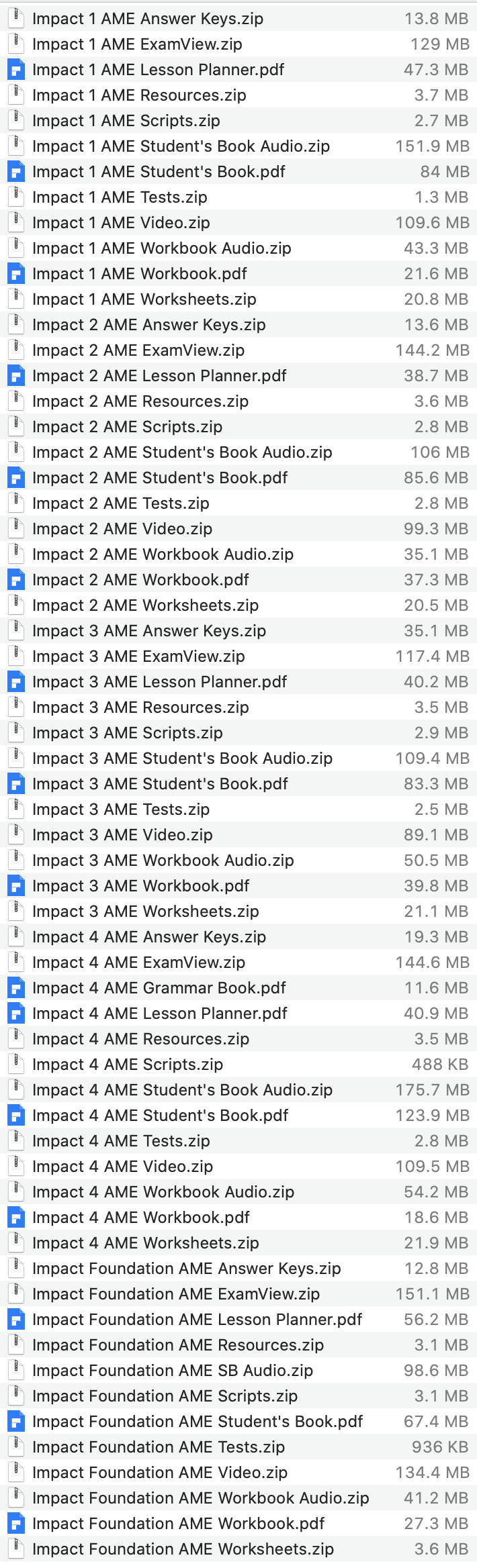
Impact Foundation Answer Keys.zip
Impact Foundation ExamView.zip
Impact Foundation Lesson Planner.pdf
Impact Foundation Resources.zip
Impact Foundation SB Audio.zip
Impact Foundation Scripts.zip
Impact Foundation Student’s Book.pdf – Sample: Click
Impact Foundation Tests.zip
Impact Foundation Video.zip
Impact Foundation Workbook Audio.zip
Impact Foundation Workbook.pdf – Sample: Click
Impact Foundation Worksheets.zip
Level 1 (A2)
Impact 1 Answer Keys.zip
Impact 1 ExamView.zip
Impact 1 Lesson Planner.pdf
Impact 1 Resources.zip
Impact 1 Scripts.zip
Impact 1 Student’s Book Audio.zip
Impact 1 Student’s Book.pdf – Sample: Click
Impact 1 Tests.zip
Impact 1 Video.zip
Impact 1 Workbook Audio.zip
Impact 1 Workbook.pdf – Sample: Click
Impact 1 Worksheets.zip
Level 2 (B1)
Impact 2 Answer Keys.zip
Impact 2 ExamView.zip
Impact 2 Lesson Planner.pdf
Impact 2 Resources.zip
Impact 2 Scripts.zip
Impact 2 Student’s Book Audio.zip
Impact 2 Student’s Book.pdf – Sample: Click
Impact 2 Tests.zip
Impact 2 Video.zip
Impact 2 Workbook Audio.zip
Impact 2 Workbook.pdf – Sample: Click
Impact 2 Worksheets.zip
Level 3 (B1+)
Impact 3 Answer Keys.zip
Impact 3 ExamView.zip
Impact 3 Lesson Planner.pdf
Impact 3 Resources.zip
Impact 3 Scripts.zip
Impact 3 Student’s Book Audio.zip
Impact 3 Student’s Book.pdf – Sample: Click
Impact 3 Tests.zip
Impact 3 Video.zip
Impact 3 Workbook Audio.zip
Impact 3 Workbook.pdf – Sample: Click
Impact 3 Worksheets.zip
Level 4 (B2)
Impact 4 Answer Keys.zip
Impact 4 ExamView.zip
Impact 4 Grammar Book.pdf
Impact 4 Lesson Planner.pdf
Impact 4 Resources.zip
Impact 4 Scripts.zip
Impact 4 Student’s Book Audio.zip
Impact 4 Student’s Book.pdf – Sample: Click
Impact 4 Tests.zip
Impact 4 Video.zip
Impact 4 Workbook Audio.zip
Impact 4 Workbook.pdf – Sample: Click
Impact 4 Worksheets.zip
| Name | Price | Buy |
|---|---|---|
| Impact Foundation PDFs, Resources (American) | $8 | |
| Impact 1 PDFs, Resources (American) | $8 | |
| Impact 2 PDFs, Resources (American) | $8 | |
| Impact 3 PDFs, Resources (American) | $8 | |
| Impact 4 PDFs, Resources (American) | $8 | |
| Impact PDFs, Resources (American) - All 5 Levels | Original price was: $40.$35Current price is: $35. | |
| Impact PDFs, Resources (British) – All 5 Levels | $10 |
Impact Classroom Presentation Tool (Offline iTools)
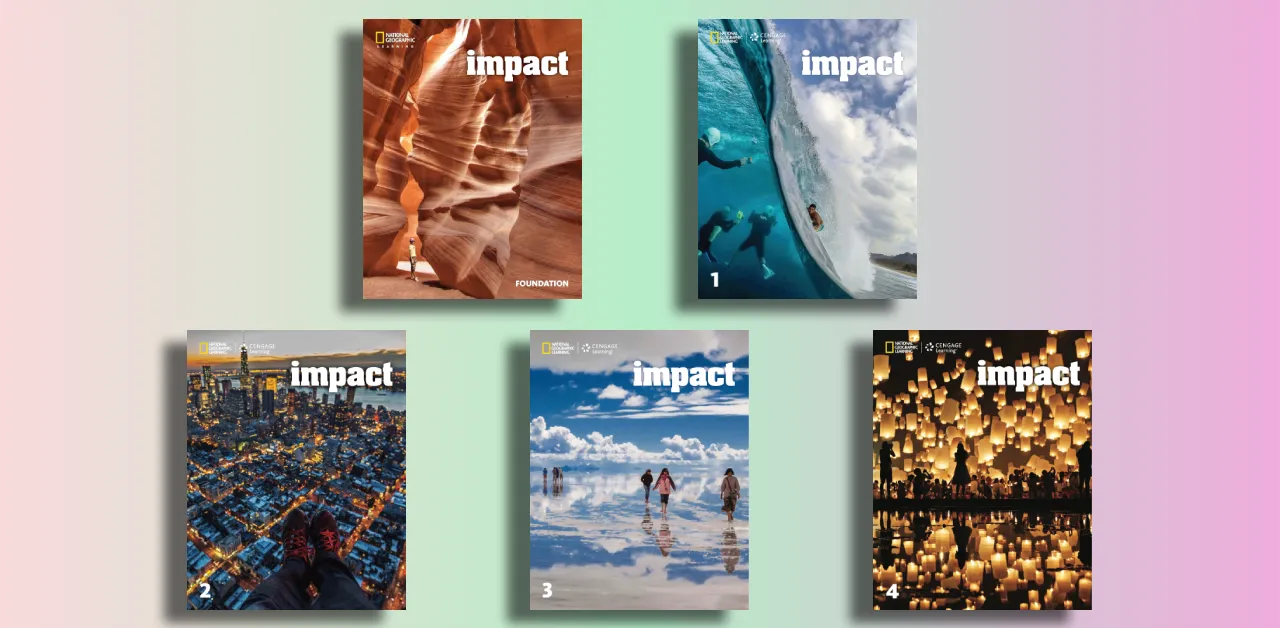
Overview of the “Impact” by National Geographic Learning
Contents
- 1 Overview of the “Impact” by National Geographic Learning
- 2 Who Is Impact Designed For?
- 3 The Educational Philosophy Behind Impact
- 4 Authentic National Geographic Content
- 5 Learning Through National Geographic Explorers
- 6 Integrated Development of the Four Skills
- 7 Vocabulary and Grammar in Context
- 8 Critical Thinking and 21st-Century Skills
- 9 Global Citizenship and Intercultural Awareness
- 10 Learner Choice and Active Participation
- 11 Typical Unit Experience
- 12 Course Components and Teaching Resources
- 13 Major Strengths of Impact
- 14 Is Impact Suitable for Exam Preparation?
- 15 Is Impact Suitable for Self-Study?
- 16 Who Should Choose Impact?
- 17 Final Evaluation
- 18 Frequently Asked Questions About Impact
| ✅ Coursebook: | Impact |
| ✅ Publisher: | National Geographic Learning |
| ✅ English type: | British English, American English |
| ✅ For: | Secondary, Teenager Learners |
| ✅ Levels: | Pre A1, A1, A2, B1, B2 |
| ✅ Publication year: | 2025 |
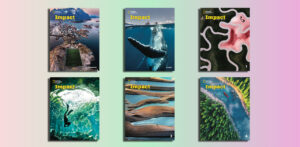
Impact by National Geographic Learning is a five-level English-language course created for teenage learners who need more than grammar exercises and controlled classroom conversations. Through powerful photography, real-world stories, cross-curricular topics, and encounters with National Geographic Explorers, the series connects language learning with questions about identity, society, culture, science, and the natural world.
The course is designed around a clear educational principle: teenagers learn more effectively when English helps them understand subjects that genuinely matter to them. Rather than treating language as an isolated school subject, Impact presents it as a tool for discovering the world, communicating ideas, and participating in meaningful discussions.
Available in both American and British English editions, the original series consists of five levels, from Foundation to Level 4. It broadly supports learners from elementary proficiency to upper-intermediate level, making it suitable for several years of secondary-school English instruction.
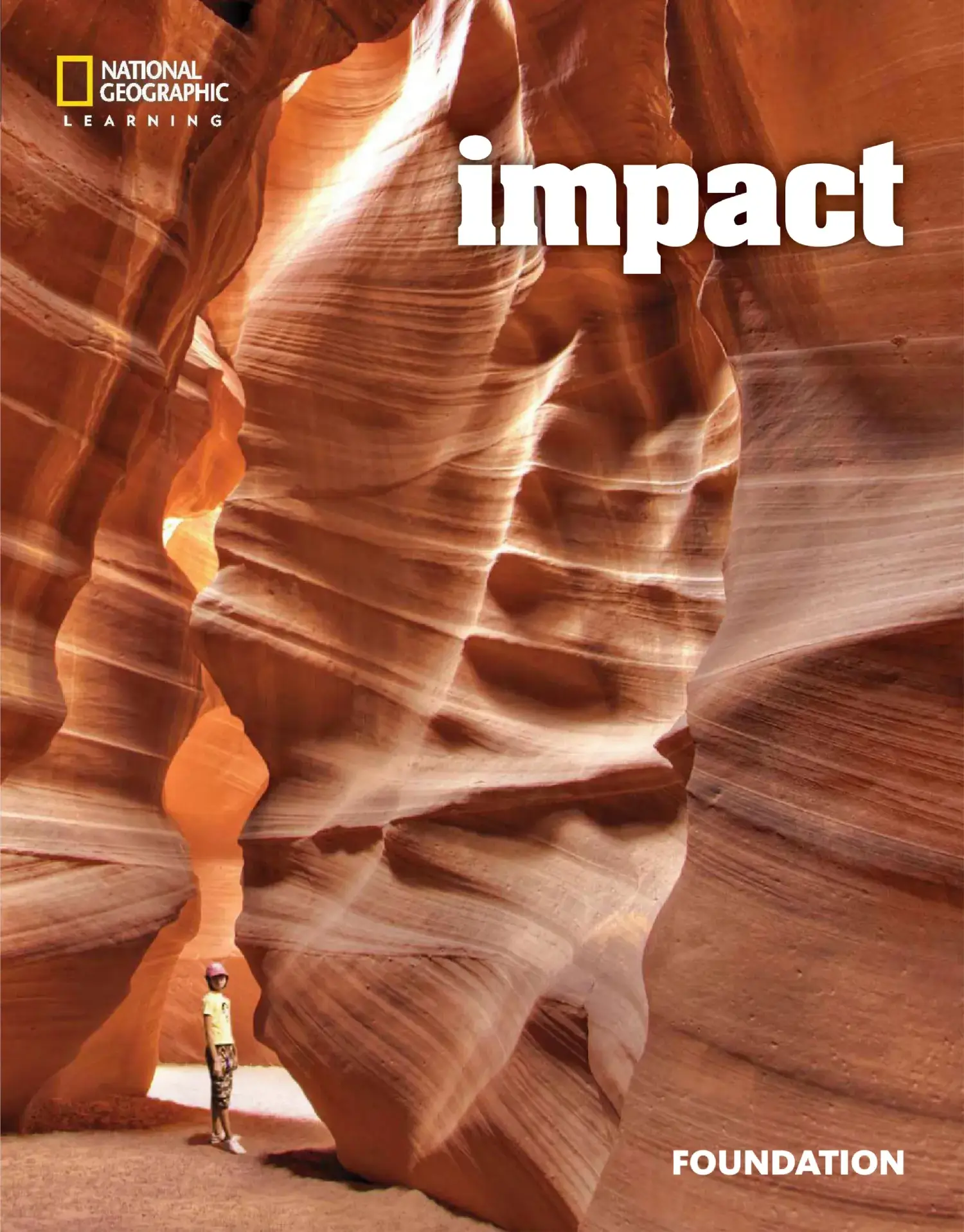
Impact Foundation Student’s Book
What Is Impact by National Geographic Learning?
Impact is an integrated-skills English course developed specifically for adolescent learners. It combines systematic instruction in vocabulary, grammar, pronunciation, reading, listening, speaking, and writing with content inspired by National Geographic’s global storytelling tradition.
The series aims to help students understand three interconnected areas:
- who they are as individuals;
- how they relate to other people;
- how they can participate responsibly in the wider world.
This focus gives the course a distinctive identity. Students do not simply learn how to describe people, places, and events. They are regularly encouraged to express opinions, examine different perspectives, make choices, solve problems, and consider how their actions may affect others.
As a result, Impact can support both linguistic development and broader educational goals such as critical thinking, collaboration, creativity, intercultural awareness, and learner independence.
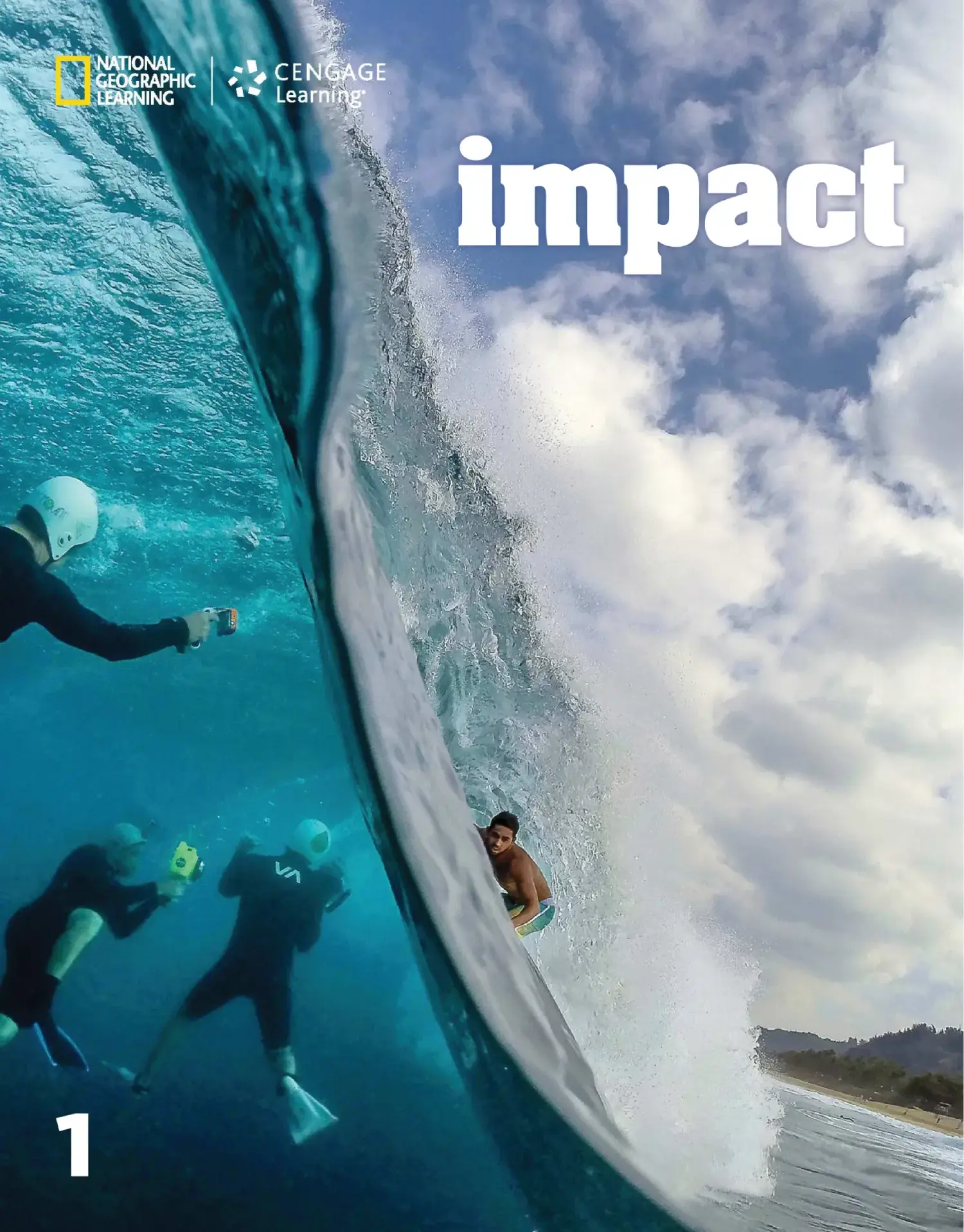
Impact 1 Student’s Book
Who Is Impact Designed For?
Impact is primarily designed for learners in their early and middle teenage years. It works particularly well with secondary-school students who have moved beyond children’s English courses but are not yet ready for materials written for university students or adults.
The series may be suitable for:
- lower- and upper-secondary English programmes;
- private language centres;
- bilingual and international schools;
- after-school English courses;
- intensive summer programmes;
- small-group tutoring;
- structured home learning with teacher or parental support.
Its visual design, age-appropriate topics, and real-world content help bridge the difficult transition between primary and secondary English education. The materials respect teenagers’ growing intellectual maturity without overwhelming them with adult-oriented themes or unnecessarily academic language.

Impact 2 Student’s Book
The Educational Philosophy Behind Impact
One of the strongest features of Impact is the way its methodology reflects the developmental needs of teenage learners. Adolescence is a period when students are forming their identities, questioning established ideas, and becoming more aware of communities beyond their immediate environment.
The course responds to this stage by organising learning around self-expression, participation, and global awareness.
Students are not presented as passive recipients of information. Instead, they are asked to interpret what they see, connect new content with their own lives, and contribute ideas to classroom tasks.
This learner-centred approach can increase engagement because it gives students a meaningful reason to use English. Language becomes a resource for exploring ideas rather than merely a collection of rules to memorise.
Authentic National Geographic Content
National Geographic photography and storytelling are central to the learning experience. Units introduce real people, locations, cultures, environmental questions, scientific discoveries, and human achievements.
This content serves several pedagogical purposes.
First, it creates immediate visual interest. Strong images can stimulate curiosity before students begin reading or listening. They also provide contextual support, making unfamiliar vocabulary and ideas easier to understand.
Second, real-world stories give language tasks a clearer purpose. Students may read to discover how a community solves a problem, listen to an explorer describe fieldwork, or discuss how an environmental decision affects different groups.
Third, global content exposes learners to a wider range of lives and perspectives. When handled thoughtfully by the teacher, this can develop cultural awareness and encourage students to move beyond stereotypes.
The content is therefore not decorative. It forms the intellectual and emotional foundation of many lessons.
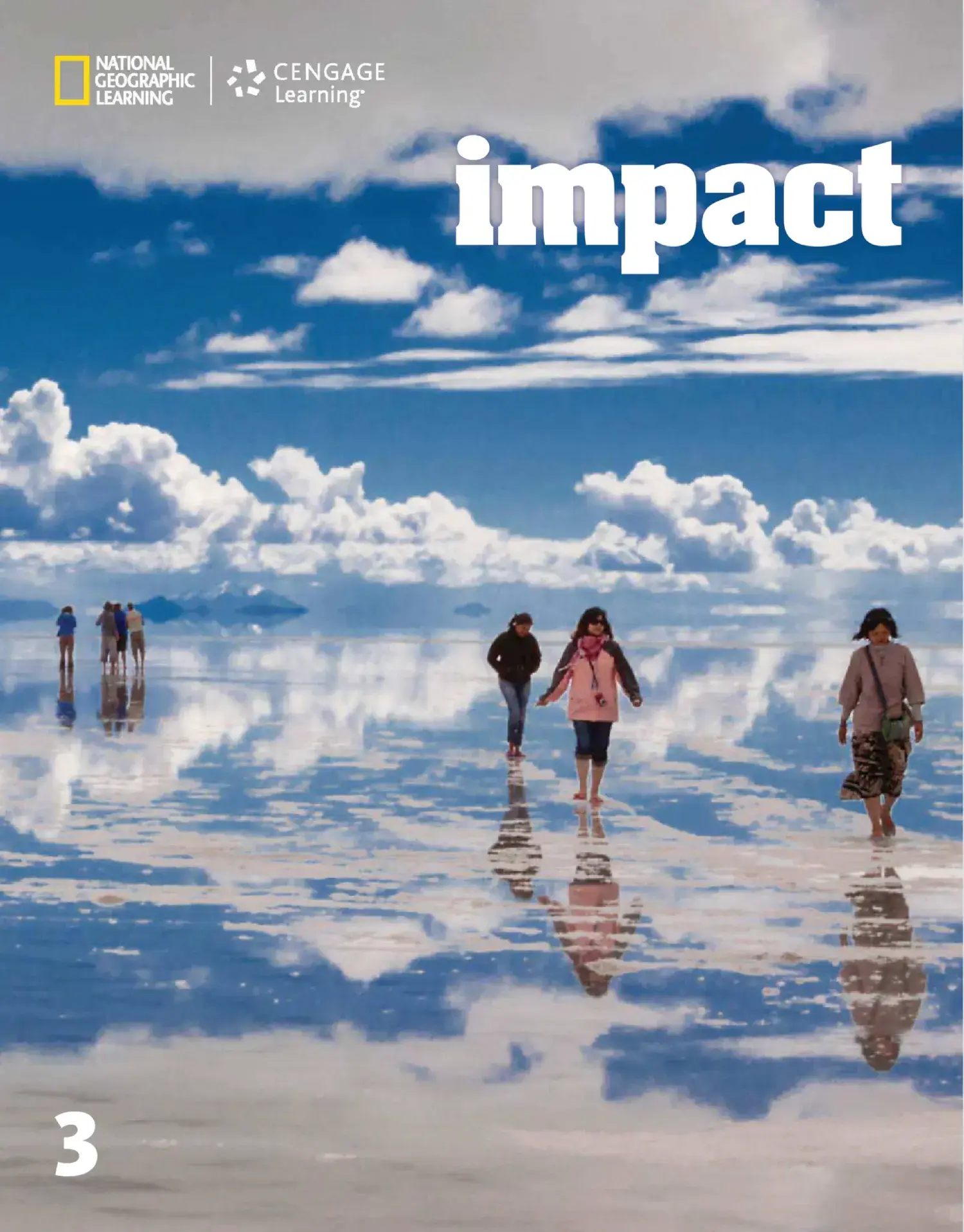
Impact 3 Student’s Book
Learning Through National Geographic Explorers
National Geographic Explorers appear throughout the series as scientists, photographers, conservationists, researchers, educators, filmmakers, and community leaders.
These individuals offer teenagers visible examples of how curiosity, knowledge, creativity, and persistence can be applied in the real world. Their stories can also broaden students’ understanding of careers and achievement.
Importantly, the Explorers are not presented only as distant celebrities. Their experiences often become starting points for classroom questions and projects. Students may be asked to reflect on an Explorer’s choices, identify the skills required for a particular project, or consider how they could contribute to their own communities.
This connection between language education and real human experience is one of the qualities that distinguishes Impact from more conventional coursebooks.
Integrated Development of the Four Skills
Impact develops reading, listening, speaking, and writing within a connected unit structure. Skills are not taught as unrelated classroom activities. A reading or video may introduce a topic, vocabulary work may prepare students to discuss it, and a final project may require them to combine information from several parts of the unit.
Reading
Reading texts expose students to different genres and subject areas. Tasks generally progress from understanding the main idea to locating details, making inferences, interpreting purpose, and responding personally to the content.
Visual information such as photographs, captions, maps, and diagrams may also support comprehension and encourage multimodal literacy.
Listening
Listening activities help learners process conversations, interviews, presentations, and topic-based recordings. Students practise identifying key information as well as understanding speakers’ intentions, attitudes, and supporting details.
Repeated exposure to meaningful spoken English can also improve pronunciation awareness and prepare students for more spontaneous communication.
Speaking
Speaking has a particularly important role in the course. Pair work, group discussion, personal-response questions, presentations, role plays, and collaborative projects give students repeated opportunities to express themselves.
Many tasks allow some degree of student choice. This can increase personal investment and reduce the feeling that every learner must produce exactly the same answer.
Writing
Writing instruction moves from controlled language practice towards more organised and purposeful texts. Learners work with models, planning support, language prompts, and clear outcomes.
Depending on the level, students may produce descriptions, messages, narratives, opinion paragraphs, reports, presentations, or project-related texts.

Impact 4 Student’s Book
Vocabulary and Grammar in Context
Although Impact places strong emphasis on content and communication, it does not neglect systematic language instruction.
Vocabulary is introduced through meaningful topics, images, readings, audio, and video. Students meet target words in context before using them in guided and more personalised activities.
Grammar is similarly linked to communicative situations. Structures are presented as tools for expressing meaning rather than as isolated formulas. Explanations and tables provide clarity, while exercises help learners progress from recognition to controlled production and freer use.
This balance is important. Teenagers need engaging content, but they also need sufficient repetition, explanation, and feedback to develop accuracy. Impact attempts to combine both priorities within the same learning sequence.
Critical Thinking and 21st-Century Skills
Modern language education increasingly requires learners to do more than reproduce information. They must learn to analyse, evaluate, compare, create, and communicate.
Impact supports these abilities through activities that ask students to:
- distinguish facts from opinions;
- identify causes and consequences;
- compare different viewpoints;
- organise and classify information;
- interpret visual evidence;
- propose solutions;
- make justified choices;
- collaborate on projects;
- present ideas to an audience;
- reflect on their own learning.
These tasks can make English lessons more cognitively meaningful. However, their success depends on classroom implementation. Teachers may need to provide language frames, examples, planning time, and differentiated support, especially when students have interesting ideas but limited English.
Global Citizenship and Intercultural Awareness
Global citizenship is one of the defining themes of the series. Students encounter questions involving communities, cultural diversity, environmental responsibility, human innovation, and shared global challenges.
The purpose is not to tell learners what to think. At its best, the course encourages them to examine evidence, recognise different perspectives, and consider their own responsibilities.
This approach can be particularly valuable in English education because language learning naturally brings students into contact with people and ideas beyond their local environment.
Teachers should nevertheless adapt discussions to learners’ ages, language levels, and cultural contexts. Sensitive topics may require additional explanation, balanced viewpoints, or carefully structured participation.
Learner Choice and Active Participation
Many traditional coursebooks position the teacher as the main decision-maker and students as followers of instructions. Impact introduces more opportunities for learners to select topics, personalise responses, divide project responsibilities, and decide how to present their work.
Choice can improve motivation, but it also develops educational independence. Students learn that successful communication involves planning, decision-making, cooperation, revision, and responsibility.
For teachers, the goal is to provide enough structure for students to succeed without removing every element of independence.
Typical Unit Experience
Although individual levels vary, a typical Impact unit may include:
- a visually engaging introduction to the unit theme;
- topic-based vocabulary development;
- grammar presented and practised in context;
- reading and listening texts connected with real-world content;
- pronunciation and communication work;
- speaking tasks requiring personal responses;
- writing development with models and guidance;
- video featuring places, stories, or National Geographic Explorers;
- critical-thinking or cross-curricular activities;
- a final project, presentation, or student-choice task.
This progression allows teachers to move from language input to guided practice and then towards more independent production.
Course Components and Teaching Resources
The complete Impact programme may include a range of print, audio, video, assessment, and teacher-support materials. Availability can vary by market, edition, and product package.
Common components and resources include:
- Student’s Book;
- Workbook;
- Student’s Book audio;
- Workbook audio;
- grammar support;
- Teacher’s Book or Lesson Planner;
- answer keys;
- video materials;
- audio and video scripts;
- placement tests;
- unit and progress tests;
- ExamView assessment resources;
- worksheets;
- reading texts;
- vocabulary lists;
- graphic organisers;
- pacing guides;
- printable classroom resources.
These materials make the series suitable for both established school programmes and teachers who need additional support with lesson planning, homework, assessment, and differentiation.
Major Strengths of Impact
Highly engaging visual content
National Geographic photography gives the books a strong visual identity and can motivate students who are less responsive to text-heavy materials.
Meaningful topics for teenagers
The course addresses identity, choices, communities, exploration, science, culture, and the environment without presenting the content in an overly childish way.
Strong connection between language and content
Students learn English while exploring real information. This can build general knowledge and support future academic study.
Emphasis on communication
Speaking tasks, collaborative activities, and projects provide frequent opportunities for students to use English for a clear purpose.
Balanced language development
Vocabulary and grammar remain systematic, even though the course has a strong communicative and content-based orientation.
Development of transferable skills
Critical thinking, collaboration, creativity, presentation skills, and learner independence are embedded across the course.
Flexible support for teachers
The wider resource package can assist with placement, lesson planning, classroom practice, homework, review, and assessment.
Points Teachers and Schools Should Consider
No coursebook is equally suitable for every teaching context. Schools considering Impact should evaluate several factors.
Some content may be linguistically demanding
Students with limited vocabulary or weak reading habits may need pre-teaching, simplified instructions, or additional comprehension support.
Visual engagement does not replace language practice
The photography and videos are motivating, but learners still require deliberate review and recycling to retain vocabulary and grammar.
Projects require classroom time
Collaborative tasks can produce valuable learning, but they need clear roles, deadlines, assessment criteria, and teacher monitoring.
Cultural topics may need localisation
Teachers should connect global themes with students’ own experiences and avoid treating unfamiliar cultural practices superficially.
Placement remains essential
Students of the same age may have very different English backgrounds. Age or school grade alone should not determine the course level.
Is Impact Suitable for Exam Preparation?
Impact is primarily a general English course rather than a dedicated examination-preparation programme. It develops many abilities that support later exam success, including reading comprehension, listening, vocabulary, grammar, speaking fluency, structured writing, and critical thinking.
Its CEFR progression can also prepare learners for future work towards qualifications such as Cambridge English examinations or IELTS.
However, students approaching a specific examination will normally need additional materials covering:
- the official test format;
- timing strategies;
- task-specific techniques;
- assessment criteria;
- complete practice papers;
- targeted error analysis.
Impact can therefore provide a strong language foundation, while an exam course can later develop familiarity with the requirements of a particular test.
Is Impact Suitable for Self-Study?
The Student’s Book, Workbook, audio, and video resources can support independent practice, especially for motivated learners. Nevertheless, the series is most effective when used with a teacher.
Many of its strongest features—discussion, collaboration, projects, presentation, feedback, and interaction—depend on participation with other people. A self-study learner may complete vocabulary, grammar, reading, and listening activities successfully but will need additional ways to practise speaking and receive feedback on writing.
For home learning, a blended approach involving independent study and regular tutoring is likely to produce better results than completely unsupported use.
Who Should Choose Impact?
Impact is a strong choice for schools and teachers seeking a course that:
- is designed specifically for teenagers;
- combines language instruction with real-world content;
- develops all four language skills;
- includes systematic vocabulary and grammar;
- encourages discussion and personal expression;
- introduces global and cross-curricular themes;
- supports project-based learning;
- develops critical thinking and collaboration;
- offers both American and British English versions;
- provides a multi-level pathway towards B2.
It may be less appropriate for programmes that require intensive test drilling, highly controlled grammar translation, or a course focused exclusively on everyday conversation.
Final Evaluation
Impact by National Geographic Learning presents English as a means of understanding, communicating, and participating in the world. Its value lies not simply in the quality of its photography or the appeal of its videos, but in the connection it creates between language, knowledge, identity, and action.
The course provides a structured progression in grammar, vocabulary, and the four skills while giving teenagers space to ask questions, share ideas, collaborate, and consider perspectives beyond their immediate experience.
Used with thoughtful teaching, appropriate placement, and sufficient language support, Impact can help students become more capable English users and more confident participants in their classrooms and communities.
For secondary programmes seeking a balance between linguistic rigour, visual engagement, global content, and twenty-first-century learning, the original five-level Impact series remains a distinctive and educationally valuable option.
Frequently Asked Questions About Impact
What age group is Impact designed for?
- Impact is designed mainly for teenage learners, particularly students in lower- and upper-secondary education.
How many levels are in the original Impact series?
- The original edition contains five levels: Foundation, Impact 1, Impact 2, Impact 3, and Impact 4.
What CEFR levels does Impact cover?
- The complete original series broadly progresses from A1 to B2. Individual levels lead learners through intermediate stages such as A1+, A2, B1, and B1+.
Is Impact available in American and British English?
- Yes. The original series was produced in both American and British English versions.
Does Impact teach grammar?
- Yes. Grammar is presented, explained, and practised systematically, but it is generally connected to meaningful topics and communication.
Does Impact include video?
- Yes. Video is an important part of the programme and is used to introduce real places, global topics, and National Geographic Explorers.
Can Impact be used for Cambridge English or IELTS preparation?
- It can build a strong general-English foundation, but learners preparing for a specific examination should also use dedicated exam-practice materials.
What is the difference between Impact and Impact, Second Edition?
- The original Impact is a five-level course from Foundation to Level 4. Impact, Second Edition is a newer series with six levels, including a Starter level, updated National Geographic content, and revised language and communication support.