Show and Tell 2nd Edition (PDFs, Resources)
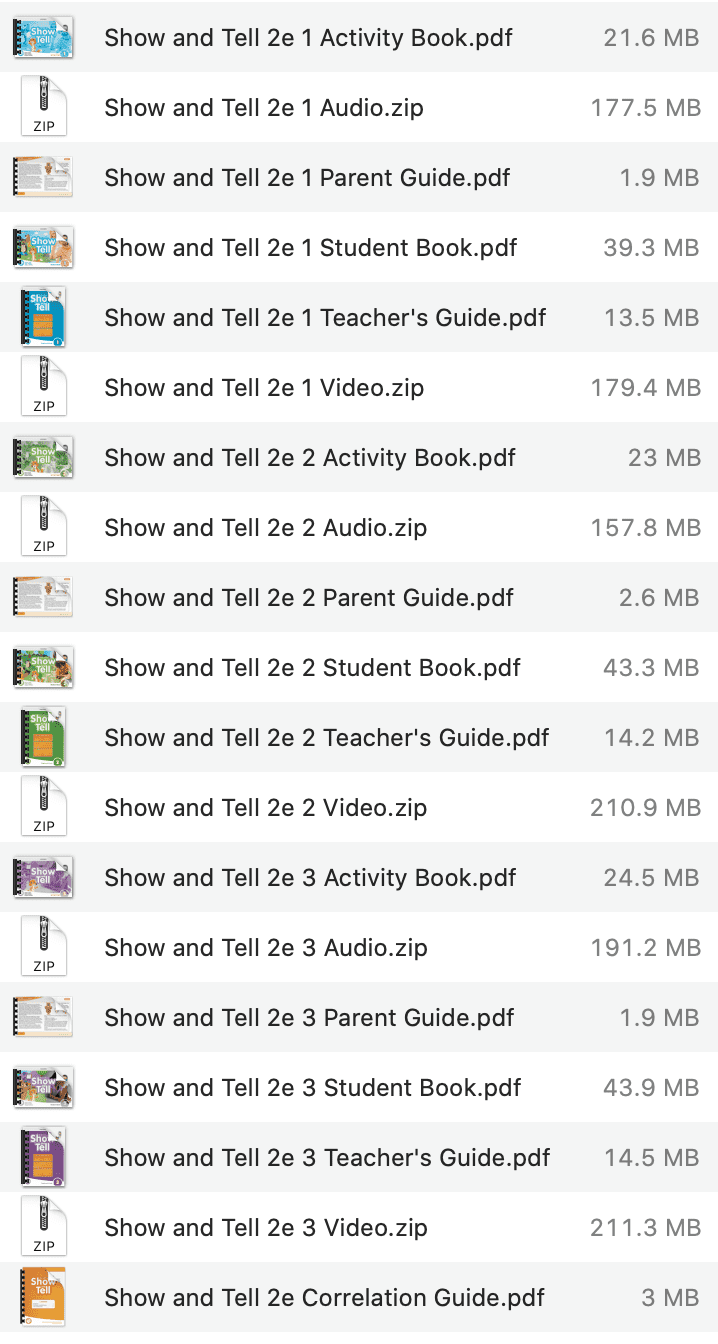
Level 1
Show and Tell 2e 1 Activity Book.pdf – Sample: Click
Show and Tell 2e 1 Audio.zip
Show and Tell 2e 1 Parent Guide.pdf
Show and Tell 2e 1 Student Book.pdf – Sample: Click
Show and Tell 2e 1 Teacher’s Guide.pdf
Show and Tell 2e 1 Video.zip
Level 2
Show and Tell 2e 2 Activity Book.pdf – Sample: Click
Show and Tell 2e 2 Audio.zip
Show and Tell 2e 2 Parent Guide.pdf
Show and Tell 2e 2 Student Book.pdf – Sample: Click
Show and Tell 2e 2 Teacher’s Guide.pdf
Show and Tell 2e 2 Video.zip
Level 3
Show and Tell 2e 3 Activity Book.pdf – Sample: Click
Show and Tell 2e 3 Audio.zip
Show and Tell 2e 3 Parent Guide.pdf
Show and Tell 2e 3 Student Book.pdf – Sample: Click
Show and Tell 2e 3 Teacher’s Guide.pdf
Show and Tell 2e 3 Video.zip
Show and Tell 2e Correlation Guide.pdf
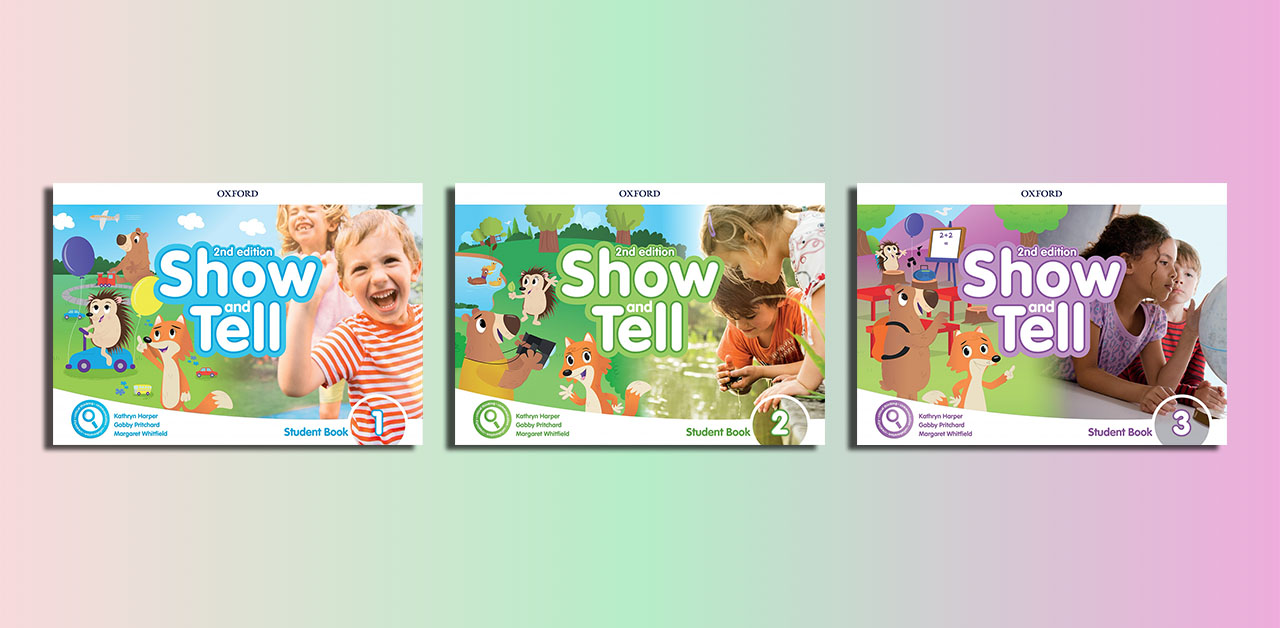
Overview of the “Show and Tell 2nd Edition” by Oxford
Contents
| ✅ Coursebook: | Show and Tell 2nd Edition |
| ✅ Authors: | Gabby Pritchard, Margaret Whitfield, Kathryn Harper |
| ✅ Publisher: | Oxford University Press |
| ✅ For: | Preschool, Kindergarten |
| ✅ Level: | Pre A1 |
| ✅ Publication year: | 2019 |
“Show and Tell 2nd Edition” by Oxford University Press is a three-level pre-primary English course (Levels 1–3) designed for very young learners at Pre-A1 level. It combines play-based learning, storytelling, and inquiry with systematic language development to prepare children for primary school and for future learning in English.
At the heart of the course is an inquiry-based approach: each unit is built around a Big Question (for example “What can you find outside?” or “How do we make music?”) that children explore through stories, songs, games, and hands-on activities. This approach encourages learners to notice, ask questions, predict, and share ideas, so language learning is always connected to real-world experiences. It also supports the development of key 21st-century skills – critical thinking, communication, collaboration, and creativity – which Oxford presents as core outcomes of the Second Edition.
Course structure and levels
Show and Tell 2nd Edition is a three-level course for children in preschool and kindergarten, typically ages 3–6. Each level provides a full year of instruction and follows a consistent unit structure so children feel secure and know what to expect. The levels build gradually from simple vocabulary and chunks to more confident spoken production and early literacy:
- Level 1 – introduces key vocabulary, basic classroom language, simple chunks and expressions; develops listening and speaking confidence.
- Level 2 – expands vocabulary sets, introduces more communicative tasks, and reviews the alphabet through the Literacy Book while reinforcing sound–letter connections.
- Level 3 – consolidates and extends; learners work with slightly longer texts, review and extend phonics (including common vowel sounds), and prepare for the transition to primary courses such as Oxford Discover.
Across levels, “Hello” units help activate or re-teach core language at the start of the year, and review sections recycle vocabulary and structures after every few units. The Second Edition also adds an “It’s a wrap!” unit at the end of the Student Book so children can revisit the key language and celebrate progress, and a special “Show and Tell Show” performance unit where learners sing, act and present in English.
Methodology and learning experience
Show and Tell 2nd Edition is built around Big Questions and real-world themes, which give each unit a clear purpose and context. Children encounter the question at the beginning, explore it through stories, CLIL pages, songs and projects, and then “show and tell” what they have discovered at the end. This cycle encourages genuine communication, even at very low levels, because learners are talking about their own lives and ideas rather than only repeating models.
The course strongly integrates values and social-emotional learning – for example, topics such as family, friendship, feelings and caring for nature are woven into the stories and tasks. These themes are reinforced through songs, role-plays, and simple projects that encourage sharing, turn-taking, and cooperation. Combined with playful characters and colourful artwork, this creates a warm, reassuring classroom atmosphere that is particularly suitable for very young children.
Show and Tell also provides systematic skills development:
- Listening & Speaking: repetitive songs and chants, action games, and simple information-gap activities give plenty of practice with natural rhythm and intonation.
- Phonics & Literacy: the Literacy Book sequences phonics step by step, from letter recognition to reading short texts, rhymes and simple stories; guidance suggests using it regularly before “Say it with me” speaking lessons.
- Numeracy & CLIL: Numeracy Books and CLIL pages connect English to maths and science concepts, helping children transfer thinking skills across subjects.

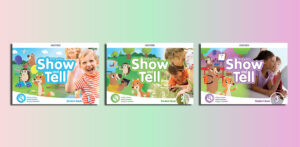
Show and Tell 2nd Edition 1 Student Book
Who is suitable for “Show and Tell 2nd Edition”?
“Show and Tell 2nd Edition” is ideal for very young, pre-primary learners and the adults who support them around that age group.
1. Learners
This course is suitable for:
- Preschool / kindergarten children (approx. ages 3–6) who are starting English from zero or have only a little exposure. The course is written at Pre-A1 level and moves very gently, with lots of repetition and recycling.
- Children who learn best through play, stories and hands-on activities – Show and Tell uses songs, games, craft, projects and TPR-style activities rather than heavy workbook-only learning.
- Learners who need strong school-readiness skills: listening, speaking, early literacy (phonics, letter formation, reading very short texts) and basic numeracy (numbers, shapes, patterns) so they can transition smoothly into primary courses such as Oxford Discover.
- Children who are naturally curious about the world – each unit revolves around a Big Question (e.g. Who makes you happy? What do our senses tell us?) so it suits learners who enjoy exploring real-life topics while learning English.
2. Teaching contexts
Show and Tell 2nd Edition is also a good fit for:
- Kindergartens and pre-primary schools that want a full, structured English programme with clear progression over three levels and strong links to primary courses.
- Language centres running early-years English classes (weekend, after-school or intensive holiday programmes) that need lots of ready-made resources: flashcards, posters, videos, audio, projects and digital tools for interactive lessons.
- Teachers who may be new to pre-primary and want detailed guidance – the Teacher’s Book, Classroom Presentation Tool and Teacher Resource Centre provide step-by-step support, extra worksheets and even methodology videos.
- Parents and schools that value home–school connection – the LingoKids app and parent support materials make it easy for families to review songs, vocabulary and stories at home.
If your goal is to give 3–6-year-olds a gentle, play-based start to English and build thinking skills, creativity and confidence for primary school, then “Show and Tell 2nd Edition” is a very strong match.
Show and Tell 2nd Edition 2 Student Book
The benefits of “Show and Tell 2nd Edition”
1. Builds real communication and confidence
- Each unit starts with a Big Question (e.g. Who makes you happy?), so children use English to talk about their own lives, not just repeat single words.
- Regular “Show and Tell” moments let children present projects to classmates or family and say what they have learned in English, which builds confidence and pride.
2. Develops 21st-century skills from an early age
- The Second Edition is designed to develop critical thinking, communication, collaboration and creativity through projects, problem-solving tasks, and simple group work.
- Big Questions and real-world topics encourage learners to ask questions, explore, and find their own answers, so they become active learners, not passive listeners.
3. Strong foundation in literacy and numeracy
- The course includes separate Literacy and Numeracy books at each level, helping children build early reading, writing, counting and simple maths skills alongside English.
- Stories, hand–eye coordination work, and letter-formation activities gradually lead to reading and writing simple sentences, giving a careful step-by-step literacy path.
4. Smooth transition to primary school
- Oxford describes it as a three-level course that equips children with the communication and thinking skills they need to move smoothly into Primary and into courses like Oxford Discover.
- Classroom routines, values lessons, and basic study skills (listening, following instructions, working with a partner) help children feel ready for more formal learning.
5. Highly engaging, child-friendly design
- The Student Book is “packed full of interesting content” with colourful characters, songs, stories, and games that keep mixed-ability classes engaged and motivated.
- Activities make use of movement, craft and simple experiments, tapping into children’s natural curiosity and energy so lessons feel like play.
6. Clear values and social-emotional learning
- Values lessons teach children how to behave in class and in daily life (e.g. sharing, helping others, respecting rules), supporting social-emotional development, not just language.
- Stories and topics about family, friends and feelings provide chances to talk about kindness, cooperation and empathy in simple English.
7. Comprehensive support for teachers
- Teachers get a wide range of resources: Student Book, Activity Book, Literacy and Numeracy Books, Class Audio, plus Teacher’s Guide and Teacher’s Resource Centre with extra worksheets and tests.
- The methodology is clearly structured, so even teachers who are new to pre-primary can run effective, well-organised lessons with minimal prep.
8. Strong digital and home–school connection
- The Second Edition adds more digital tools such as the Classroom Presentation Tool and a home-learning app (Lingokids), giving interactive games, videos and songs that mirror the course content.
- These tools make it easy for parents to review vocabulary and songs at home, so learning continues beyond the classroom and children get more exposure to English.
9. Flexible for different schools and timetables
- Because it has many components (Student Book, Activity Book, Literacy, Numeracy, audio, video, projects), schools can adapt the course to short or long programmes, bilingual schools, or language centres.
Show and Tell 2nd Edition 3 Student Book
Effective learning strategies for “Show and Tell 2nd Edition”
1. Use the Big Question to frame the whole unit
- Start every unit by presenting and discussing the Big Question (“Who makes you happy?”, “What can you find outside?”, etc.).
- Let children predict the vocabulary and ideas that might appear. Use L1 briefly if needed, then recycle in English.
- Revisit the Big Question at the end of each lesson and again at the end of the unit so children see their progress in thinking and language.
2. Establish strong, predictable routines
- Follow a simple pattern each lesson: Hello song → Review → New language → Practice → Show and Tell / closing.
- Use the same classroom instructions (Stand up, Point, Listen, Circle, Colour…) every time so learners quickly understand and classroom management becomes easier. The Teacher’s Book and Teaching Strategies videos model these routines.
- Keep transitions short with chants or mini-games (e.g. “Clap if you hear ‘red’!”) to hold attention.
3. Maximise speaking with “little voices, big ideas”
- When you present new language, move from choral repetition → pair practice → individual production.
- Use puppets or soft toys to model mini-dialogues, then let children role-play in pairs.
- Build in frequent “turn-and-tell your partner” moments related to the Big Question (e.g. “Who makes you happy? – My grandma.”). This aligns perfectly with the inquiry-based, communication focus of the course.
4. Exploit all four books: Student, Activity, Literacy, Numeracy
- Treat the Student Book as your main story / song / vocabulary tool and the Activity Book as short, focused follow-up (no more than 10–15 minutes of sitting work per lesson).
- Use the Literacy Book regularly (ideally a fixed slot each lesson or several times a week) so phonics and letter-formation progress step by step instead of in big jumps.
- Integrate the Numeracy Book when the topic fits (numbers, patterns, shapes). Doing numeracy in English reinforces both maths and language and matches the CLIL design of the series.
5. Turn projects into real “Show and Tell” moments
- End-of-unit projects are central in this course; they allow children to collect, create and present something linked to the Big Question.
- Break each project into small steps across several lessons (e.g. draw → label → rehearse sentences → present).
- On “project day”, invite learners to stand, hold their work, and say 1–2 practised sentences (even just “This is my family” at Level 1). Give lots of praise so they associate English with success and pride.
6. Actively build 21st-century skills
- Plan at least one pair or group activity in each lesson (e.g. matching cards together, group sorting games, simple experiments) so children practise collaboration and communication.
- Ask simple thinking questions: “Is it big or small?”, “Can it fly?”, “How many…?” to train critical thinking, not just word recognition.
- Encourage creativity: let students choose colours, draw extra details, or add stickers rather than copying exactly.
7. Use songs, chants and TPR to manage energy
- Start or reset lessons with action songs and Total Physical Response (TPR): jump, clap, point, mime vocabulary. This matches the age group’s need to move and supports memory.
- Reuse key songs and chants from previous units as warm-ups; the repetition is good for confidence. Class audio and video support this.
8. Integrate values and social-emotional learning
- When a story includes a value (sharing, helping, caring for nature), pause and discuss in simple language: “Is he kind?”, “What should we do?”. This is built into the CLIL / Values lessons.
- Use role-play to practise polite language: “Please”, “Thank you”, “Sorry”.
- Reinforce good behaviour with visual rewards (stickers, stars) linked to the course characters.
9. Make the most of digital tools and Lingokids
- Use the Classroom Presentation Tool (CPT) to display the Student Book on a screen, animate images, and play audio/video quickly; this keeps lessons “heads up” and interactive.
- Send Lingokids codes home (if your school uses them) and give parents very clear instructions: which unit to open, which games or songs to try that week. The app mirrors Show and Tell content with games, videos and songs, extending exposure at home.
- Ask children occasionally, “Who played Lingokids yesterday? What did you see?” to connect home practice with the classroom.
10. Support parents and home practice
- Use Parent Letters / Guides from the Teacher’s resources (or create your own) to explain unit topics, key vocabulary and simple home activities (e.g. “Ask: What can you find outside? Take photos together.”).
- Recommend short, frequent home practice: 5–10 minutes a day of songs, picture talk, or revising flashcards is better than one long, stressful session.
11. Assess gently and continuously
- Instead of only formal tests, use ongoing observation: Can learners respond to classroom language? Can they answer the Big Question with a word or short chunk? Can they take part in the project?
- Use simple checklists based on the skills in the Teacher’s Guide (listening, speaking, early literacy, numeracy, social skills) to track progress and share feedback with parents.
12. Adapt pace to your context
- If your timetable is short, prioritise:
- Big Question & core vocabulary
- Story / song
- One key Activity Book task
- Project step.
- If you have more hours, add extra games, Literacy & Numeracy pages, and extension projects suggested in the Teacher’s Book and Teacher’s Resource Pack.
Used this way, Show and Tell 2nd Edition becomes more than a coursebook: it’s a structured framework that helps you build confident, curious, school-ready children who enjoy learning in English.